Author: Violetta

10 Oct 2022
Pettirosso

Report from 05 to 08 October 2022

This week brought us the first Water Pipits of the fall and an influx of Common Redstarts. The Pied Flycatchers have largely passed through, and the few Willow Warblers left are massively outnumbered by the Chiffchaffs. The latter are associating with Great, Blue, and Long-tailed Tits in large, mixed-species foraging flocks, a typical winter behaviour. The Starling roost at La Cassinazza is not active every night, but when it is, their mass departure at dawn is a hurried affair, much less elaborate than their arrival in the evening: they wake up at first light and begin a lively chattering; soon thereafter, with a loud rush of wing noise, they fly off as one and head out without further ado.
The waterbird checklist for this week looks much like last weeks’, both in species and in numbers.

As for me, I’m off on holiday and these reports will resume in a few weeks.

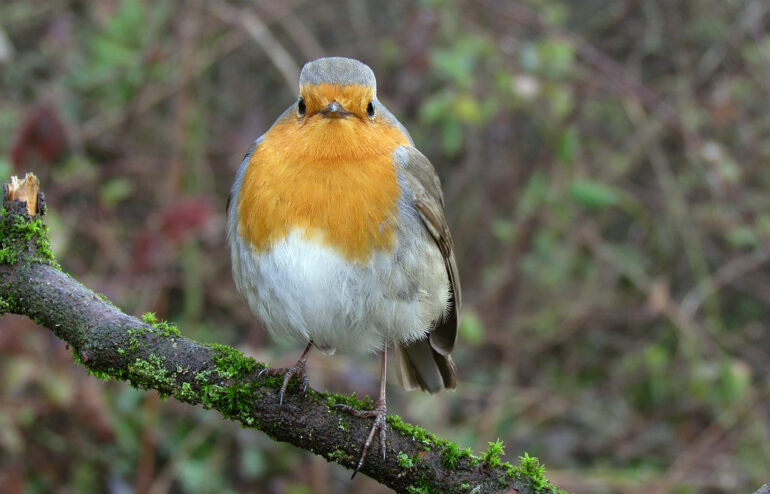
The Robins are quite in evidence this week. Having recently arrived on their wintering grounds, they are busy establishing territories, singing, challenging and chasing one another.

Pettirosso

02 Oct 2022

Report from 28 to 30 September

This week saw a new influx of Pied Flycatchers. This is likely due to different migration timing between the age classes, as the adults leave earlier and young birds a little later. Willow Warblers were also much in evidence, especially with their frequent calls. Waders mostly comprise a handful each of Common Snipe, Greenshank, Spotted Redshank, Dunlin, and Green Sandpipers, quite likely the same individuals that have been lingering for the last two weeks. The one new arrival among waterbirds was a Little Crake playing hide and seek in the reedbed for a good half hour – needless to say, it won. Turning to departures, the Squacco Herons are gone, and so are the Cattle Egrets, which probably disperse locally, although we don’t know exactly where. Nature puts on a great show in the evenings, when the Starlings fly into their roost. The first two or three begin to appear half an hour before, dusk, and start to circle over the reedbeed; soon there are twenty, thirty, then a hundred or more. They appear out of nowhere and within a few minutes there are several thousand Starlings whirling in the sky, the noise of their wings ringing loud and clear. Then, all of a sudden, as if compelled by an unknown signal, they dive into the reedbed as one. And all is silent again.
By nature, Wild Boars are diurnal, but when living in proximity to humans, they prefer to be active at night. Almost all my encounters with them are at dawn.


Cinghiale

25 Sep 2022
Volpe

Report from 21 to 24 September

The weather changed quite abruptly. From the daily highs of 30° or more that have plagued us since May, the temperatures have literally plummeted in the space of a few days. We are truly in fall now. The waterfowl are back at La Cassinazza; on some days, we are seeing as many as 1500 Mallards and 400 Teal. A Goshawk has been in the area for several weeks. At present, it is the largest and most ferocious bird of prey around. It chases after and terrorizes Little Egrets and Night Herons, but the Woodpigeons are its favourite prey. New arrivals this week included Dunlin, Chaffinch, and Tree Pipit, with good numbers of Robins, Chiffchaffs, and especially Starlings, which descend into the reedbed every evening in their thousands to spend the night. We saw the Nuthatch once again – indeed, there appear to be multiple individuals, and we can realistically hope that they will settle in for good. When Red Foxes occur near human settlements, they are almost exclusively nocturnal. They can occasionally be seen just after dawn as they return to their dens. In this case, I was just as startled as the fox: we looked at each other for a bit, then leisurely it continued on its way.

Volpe

18 Sep 2022
Usignolo di fiume

Report from 14 to 17 September 2022

We are now during a lull in migration, as most of the long-distance migrants have passed through on their way to Africa, while most of the short-distance migrants are yet to arrive. La Cassinazza seems empty: nothing to see, and nothing to hear. Even the Night Herons and Pygmy Cormorants that were so numerous until last week seem to be largely gone. The same can be said for most of the waterfowl.
And so here we were, feeling sorry for ourselves, bored from an uneventful day of birdwatching, when…. “Did you hear that? Wasn’it a…?”, “Of course it was!”…… “I see it, it’s up high” ….. “It’s hiding behind the trunk, now it’s behind a bunch of leaves”……
Until finally it was out in the open: a Eurasian Nuthach! For one brief moment it was in full sun, only to immediately fly away, a second individual in tow. This is a woodland species that only lives in the forest interior and is very reluctant to cross open areas. These pioneers have managed to reach La Cassinazza, and hopefully they fill find the local woodlands, which are now quite mature, to their liking. This is yet another new species for La Cassinazza, and our dull day was immediately brightened up.
The first Chiffchaffs and Robins of the fall made themselves known by their calls.
The only songs that ring out loud and clear are those of the Cetti’s Warblers, which are frequently heard but seldom seen. They prefer to lurk in the heart of the reedbed or in dense waterside shrubbery. The photo shows one in a typical posture, with a raised tail.

Usignolo di fiume

10 Sep 2022
Ibis sacro

Report from 07 to 10 September 2022

The week began with a quick but much-appreciated sighting of two magnificent adult Black Storks.

As the migration of Bee-eaters and Garden Warblers, which has been truly exceptional this year, draws to an end, Sedge Warblers and Common Redstarts have swelled the ranks of the songbird migrants, while the explosive calls ringing out from the reedbed herald an influx of Water Rails. On the other hands, the Purple Herons and Barn Swallows that were with us all summer were nowhere to be seen. In the dark of night, I could have sworn I head a Golden Plover overhead. Or could it have been a Grey Plover?

Once again, the Violet Dropwing (Trithemis annulata) has appeared. This is the third September in a row that we have seen this dragonfly, and we can safely say that it has colonized La Cassinazza and is now here to stay – tangible evidence of a warming climate.

Last week’s photo was dedicated to what is arguably our most nondescript bird. This week I want to feature what is undoubtedly the most hideous, despised, non-native, invasive, and damaging member of our avifauna. Behold the Sacred Ibis, in all its glorious repugnance.

Ibis sacro

04 Sep 2022
Beccafico

Report from 01 to 03 September 2022

Our heronry is quiet now: the herons are no longer going to and fro, as all the juveniles have left their nests. For the most part, they have not gone too far: they perch on bare branches and dead trees, where it is easier to land and take off. There are so many that some of the trees look like they are in fruit; white fruit if herons, and black fruit if Pygmy Cormorants. They fledged later than usual, but I think this is due to the fact that it is a brand new colony, with a few early pioneers establishing a presence, followed later by the others in mid-summer. The Starlings, which had deserted La Cassinazza during the hottest weeks of summer, are now coming back. They are attracted by the fig trees in the garden, which are bursting with fruit and are also attracting Rose-ringed Parakeets. As far as migration goes, we saw the first Willow Warbler of the fall and a few Honey Buzzards, but Garden Warblers and Bee-eaters continue to be the commonest migrants. Both seem to be passing through in unprecedented numbers here. These two species could not be any different. The colorful and noisy Bee-eaters fly acrobatically through the sky at all times of day, and perch conspicuously on power lines. The drab, nondescript, silent, and elusive Garden Warblers, instead, can only be seen early in the morning, after which they seem to disappear. They are so plain as to deserve a photograph.

Beccafico

25 Aug 2022
Orthetrum albistylum

Report of the 24 august 2022

I won’t have any more time to visit La Cassinazza this week. In the half-day at my disposal I only managed to put together a very meagre checklist, with several very common species missing. This report reflects that. Mallard numbers have now grown to well over a thousand. Among landbirds, the Bee-eaters and Garden Warblers are the most conspicuous migrants, the latter even outnumbering the Pied Flycatchers. Still, the day had a couple of nice surprises in store: a Common Redshank, and an Osprey migrating overhead. I have nothing more to report birdwise.
One of the commonest dragonfly at La Cassinazza is the White-tailed Skimmer (Orthetrum albistylum), a close relative of the Black-tailed Skimmer (Orthetrum cancellatum) that illustrated one of last month’s reports. The differences between the two species are subtle, but are evident for dragonfly enthusiasts. Can you spot the differences? A hint: the English name is a dead giveaway…


Orthetrum albistylum

21 Aug 2022
Leptotes pirithous

Report from 14 to 20 August 2022

Due to a little mishap, my travel plans went awry, and I ended up spending the Ferragosto holiday at La Cassinazza. I was richly rewarded with a new and most unexpected species for La Cassinazza: a Red-necked Grebe! This juvenile, which was swimming in one of the impoundments, was unfortunately quite wary, and rapidly disappeared into the reeds, never to be seen again. Another unusual encounter was with a Bluethroat, a species with only a handful of previous records here. The commonest migrants today were Garden Warblers, Pied Flycatchers, and yet more Bee-eaters. The first Ruff of the fall put in an appearance, and a single Pochard was in with the commoner ducks.

The Lang’s Short-tailed Blue Leptotes pirithous is a small butterfly in the family Lycaenidae, with two characteristic thin ‘tails’ on the hindwing. It is present in southern Europe and the Mediterranean. I had only seen it once before at La Cassinazza, three years ago, and did not manage to photograph it. This time I succeeded.

Leptotes pirithous

14 Aug 2022
Airone guardabuoi

Report from 09 to 13 August 2022

The ducks are once again flocking back to La Cassinazza, as they do every year at the end of the breeding season. There are currently hundreds of Mallards, dozens of Teal, a handful of Garganey and a single Shoveler. Other waterbirds migrating through right now include Common Snipe, Wood Sandpiper, Black-winged Stilt, and single-digit numbers of Greenshank, Spotted Redshank, and Green Sandpipers.
Back on dry land, the commonest migrants have been Spotted and Pied Flycatchers, Hoopoes, and flocks of Bee-eaters overhead. The reedbed sounds like it is full of Reed Warblers, but managing to glimpse even one is a real challenge.

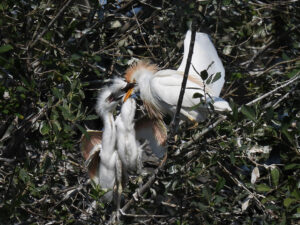
For at least two weeks now, I have noticed a complete absence of Starlings. This had never happened before in previous years; in fact, we usually saw major post-breeding Starling flocks at La Cassinazza. My best guess is that this is due to the extreme heat we have had this summer.For Cattle Egrets, feeding chicks can be a hazardous activity: one wrong move and they’ll poke your eyes out!

Airone guardabuoi

06 Aug 2022
Cavaliere d’Italia

Report from 03 to 05 August 2022

There’s only one way to define the temperatures of the last few days: out of control. I can only see a single upside: it is so hot that there aren’t even any mosquitoes around. It’s all too much, even for them.
As regards the local wildlife – birds in particular – I have very little to report: apart from the usual suspects and the hive of activity in the heronry, there is not much to see or hear. Even the typically noisy Golden Orioles have largely left. It took a great deal of patience to dig out a single migrant, a lone Great Reed Warbler. The number and variety of butterflies, dragonflies, and other insects has also bottomed out.
For the last week, a family group of Black-winged Stilts – two adults and two juveniles – has been present at La Cassinazza. The parents are very protective of their offspring, and they bravely stand between me and them, calling loudly, and every once in a while, when feeling particularly courageous, flying straight at me.

Cavaliere d’Italia