Author: Violetta

20 Dec 2024
Cinghiale

Report from 15 to 16 December 2024

The male Goshawk loudly claims his territory from near the nest that was used last year. When on the hunt, all the other birds – from the
small Common Snipe all the way up to the Grey Heron – take to the sky and flee. The female is much more reserved, and I rarely run
into her, but it is always a thrill: she is impressively large.
It looks like Mallards will remain relatively scarce this year, at least compared to previous years. There are only a tenth or so of the
numbers during the best winters, and they are easily outnumbered by Teal.
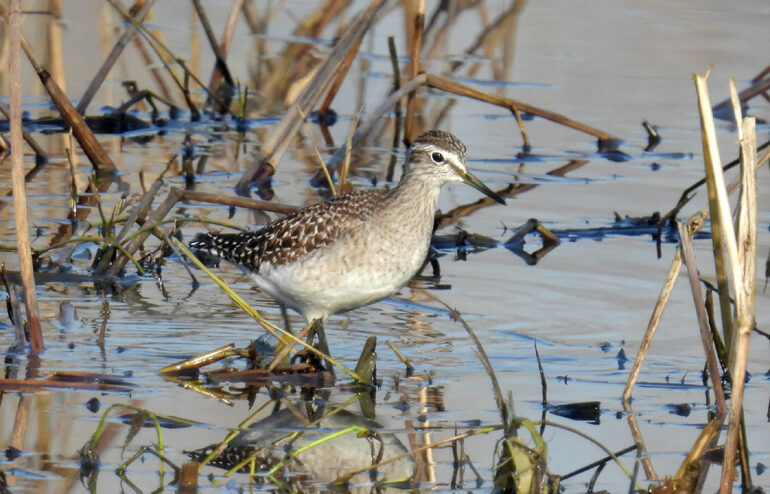
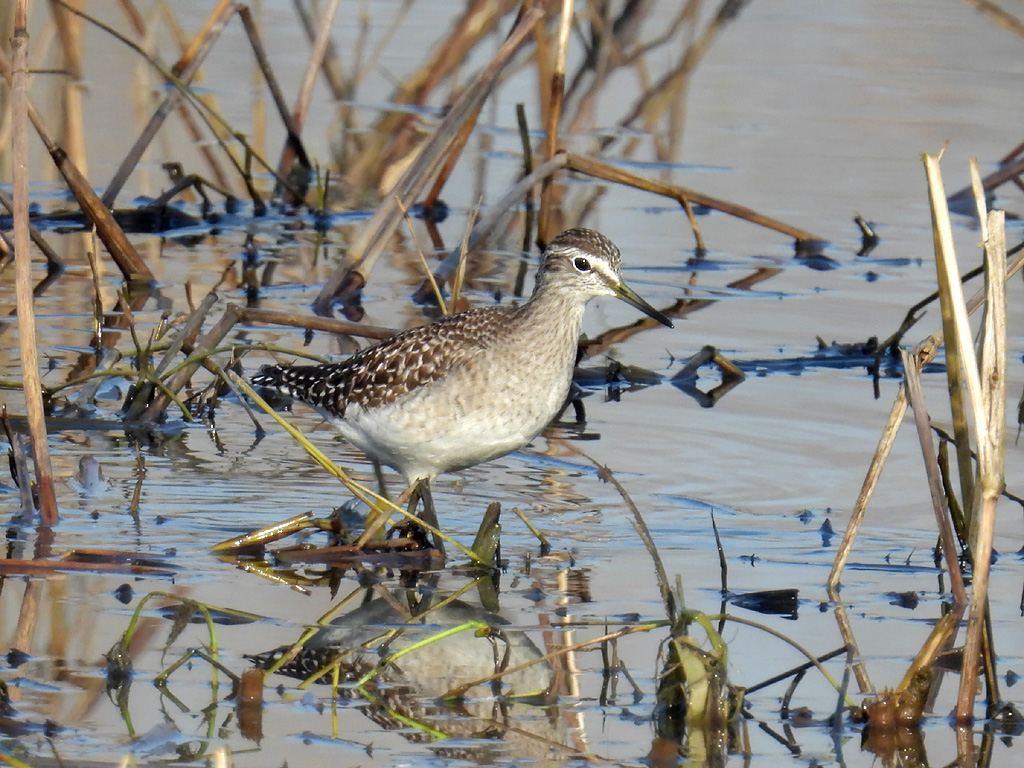
Two Wood Sandpipers continue to linger. They seem set to try to spend the winter here, which would be a most unusual occurrence.
The Wild Boars are not always a welcome guest. They roam pretty much anywhere, including in the wetlands and reedbeds, and
undoubtedly disturb the waterbirds. The swine flu epidemic has been in the news quite a bit this year. It is supposedly fatal for this
species, and was expected to decimate their numbers, but this does not seem to have happened. Perhaps Wild Boars do not read
newspapers.

Cinghiale

15 Dec 2024
Merlo

Report from 12 to 13 December 2024

When I finally returned to La Cassinazza after dealing with a minor personal issue, I found myself immersed in thick fog.
Birdwatching was impossible, but it was even more frustrating to hear: “you should have been here yesterday, it was a gorgeous
sunny day”……
On my second day here, the fog lifted just enough for me to note that very little has changed since the last time I was here: we
are in the dead of winter and we can’t really expect any major news.
I had the most fun just watching wildlife in the garden. The persimmon tree is laden with fruit. Sweet and bright orange, they are
an irresistible treat for many species of birds: Blackcap, Great Tit, Blackbird, Starling, Ring-necked Parakeet and even
Moorhens. Not so the Eurasian Collared Doves, which perch quietly on the branches of the persimmon tree without so much as
a glance at their fruit: for some reason, they do not recognize them as fruit. Neither do the Coots, which swim side by side with
the Moorhens in the pond directly below the tree, but unlike the latter do not climb its branches and seem indifferent to its bright
fruit.
Obviously, this Blackbird photo dates back to last week when the sun was shining.

Merlo


10 Dec 2024
Piro piro boschereccio

Report from 4 to 6 December 2024

Last winter, the destructive and invasive Wels Catfish were eradicated from the lake. Now, several Little Grebes and up to ten Great Crested Grebes are happily swimming there, scenes we had not seen in years since that voracious predator had invaded that body of water. Additionally, last summer a pair of Great Crested Grebe and two or three pairs of Little Grebes nested on the lake. The Common Terns also benefited from the eradication: the chicks start swimming within a few days of hatching, and make a tasty morsel for such a large fish.
The season has definitely turned wintery. In the icy dawn, the song of a Golden Oriole sounds drastically out of place, but it is merely an imitation – albeit an almost perfect one – by a Starling. The Golden Orioles are now far away; they set off for tropical Africa back in August. Wood Sandpipers should also have left long ago, but a couple of individuals are still lingering. Back in early November I already thought they were far behind schedule, but now they are in the wrong season altogether. I have been reliably told that the Wood Sandpiper is one of those species whose wintering range is gradually shifting northwards. Some are already successfully wintering in southern Italy; I don’t know if they have ever successfully overwintered in the Po Plain, but these two individuals definitely look set to try.
I would like to point out that this photo is not from the archives, but actually depicts one of these plucky individuals, taken in the cold winter light of the past few days.
Piro piro boschereccio
25 Nov 2024
Sympetrum

Report from 20 to 22 November 2024

New arrivals in recent days include Fieldfare, Mistle Thrush, and Penduline Tit. About 20 Wigeon and a dozen each Gadwall and
Shoveler are adding variety to the waterfowl, while Mallard numbers remain drastically lower than they were in past years.
I have recently received the results of the census of nesting White Storks in Lombardy. A total of 165 nests were counted regionwide,
with 256 juveniles fledged, for a fledging rate of 1.5 juveniles per nest. At La Cassinazza and its immediate surroundings three pairs of
storks have regularly nested for many years now; this year, our three nests fledged seven juveniles, an average of 2.3 per nest,
significantly higher than the regional average. It is likely that this high rate of breeding success reflects the experience of our local pairs.
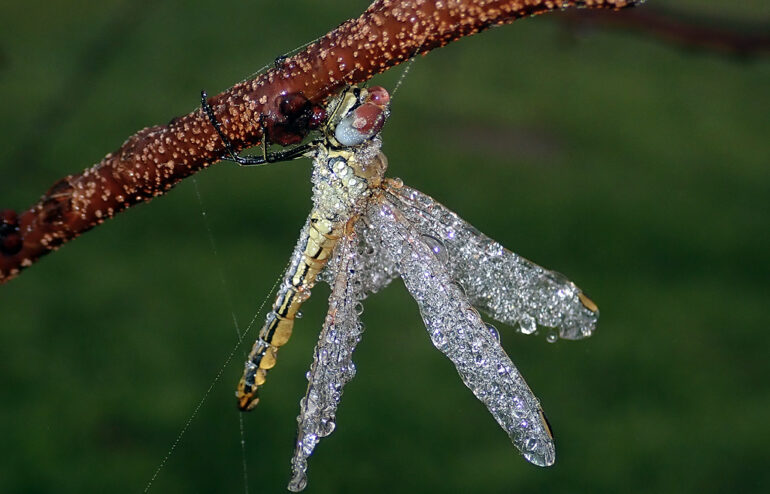
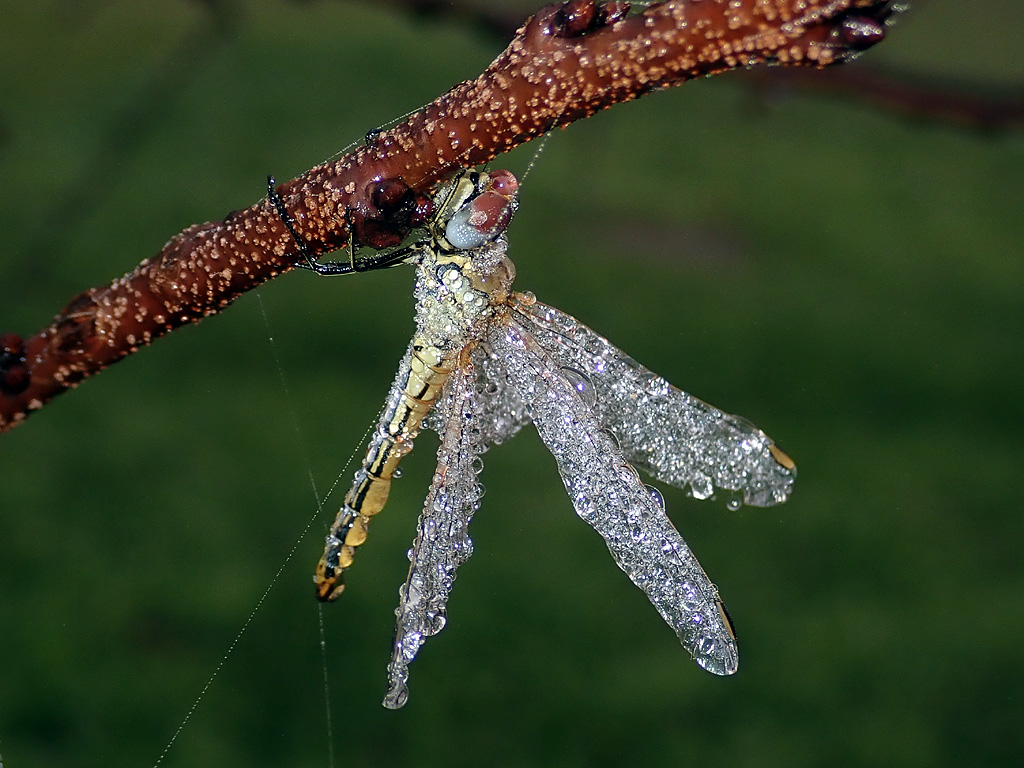
The temperatures have rapidly gotten colder, dropping to near freezing at night. Some creatures were caught unprepared.

Sympetrum

05 Nov 2024
Gru

Report from 4 to 6 November 2024

Every day, for hours on end, La Cassinazza was shrouded in fog, leaving precious little time with adequate visibility. Our contingent of wintering birds was augmented by the Linnet, Water Pipit, and Hawfinch. Among the waterfowl – about a thousand Mallards and six hundred Teal – a count of thirty Wigeon was remarkably high for here.
Cranes were migrating overhead in good numbers, especially on Tuesday, November 5th, when at least ten different flocks flew over. The flocks weren’t particularly big – usually between twenty and sixty birds – and while some were easily seen, others were either too far away or in thick fog, which did not prevent us from hearing them.
Gru
23 Oct 2024

Report from 20 to 22 October 2024

Of late, I have not really kept up the weekly schedule of the reports from La Cassinazza. This isn’t so much a reflection of my absence –
though I have been away some – but rather because several of my visits to La Cassinazza came on days of endless rain, which made
birdwatching useless. And it has to be said, this year’s fall migration has been quite meagre. So, having nothing to say, it’s best to say
nothing.
In recent days, the first Song Thrushes, Siskins, Bramblings, Meadow Pipits and Black Redstarts of the fall have arrived, along with the
Reed Buntings, which I see mostly in the late afternoon, as they return to the reedbed to roost.
Robins and Chiffchaffs are still the most conspicuous species. There has been an evident movement of Chaffinches, and albeit in much
smaller numbers, of White Wagtails and Firecrests as well. The latter is the subject of today’s photo.

Fiorrancino

07 Oct 2024
Pettirosso

Report from 5 to 6 October 2024

As some species arrive, others leave: their seasonal movements are well known and occur predictably year after year. These reports of mine reflect this, and it would not be too hard for someone to imagine that I copy them from years past. With the start of the hunting season, increasing numbers of Teal and Mallards crowd into La Cassinazza’s safe haven. As October starts, the Hobbies have left us, while several characteristic species of winter have arrived: Great Bittern, Wigeon, Gadwall, Wren, Goldcrest and Firecrest. Chiffchaffs have become numerous, while a fair number of Willow Warblers can still be heard calling.
The most conspicuous species of all is the Robin. They have only recently arrived, and are loudly challenging one another as they skirmish over the best wintering territories.
Pettirosso
02 Oct 2024
Beccaccino

Report from 24 to 26 september 2024

The natural rhythms of migration dictate local bird numbers: Reed Warblers have gotten rather thin on the ground, only a handful of Pied
Flycatchers are left, while Purple and Squacco Herons are altogether gone. On the other hand, Willow Warblers and Robins are present
in force. Like every year around this time, the number of Mallards increased ten-fold in a matter of days. Teal are also more numerous,
but only marginally so. A Goshawk is hunting them ruthlessly: they fly off in a panic at its arrival, and it repeats the operation as many
times as necessary to finally catch one. Everything then goes quiet – until the next day, that is.
It is interesting to note how the Mallards are far less intimidated by this fierce predator. In all likelihood, they know they are too big and
heavy for a male Goshawk.
Common Snipe numbers appear to swing wildly: some days they seem everywhere, and other days they are all but invisible. Perhaps
they are only well-concealed in the tall grass.

Beccaccino

21 Sep 2024
Allocco

Report from 19 to 21 semptember 2014

The most interesting discovery this week was the caterpillar of an African Death’s-head Hawkmoth (Acherontia atropos); I had never before recorded this large and now rather rare moth at La Cassinazza. The adults are spectacular, with the macabredeath’s-head pattern that gives them their name, while the caterpillars are spectacularly large. In spring, these moths migrate northwards from Africa to Europe, where they breed in the summer. Their pupae, however, struggle to survive during cold winters, and so our latitudes are re-colonized each year by individuals from further south.
Birdwise, the only news concerned the arrival of the fall’s first Robins and a new, late push of Pied Flycatchers.

I did have one reason to be very satisfied. Last year I built and put up a nest box for Tawny Owls. And now a Tawny Owl has
taken possession of it, and might have done so for some time, since I rarely check in on it. Here it is in today’s photo as it dozes
off on the front porch, with a slightly annoyed look due to the arrival of an unwelcome visitor.

Allocco