Author: Violetta

16 Sep 2024
Porciglione

Report dal 14 al 16 settembre 2024

A massive emergence of Scarlet Dragonflies (Crocothemis erythraea) encouraged the Bee-eaters to linger at La Cassinazza. Once they
reckoned they were fat enough, they gathered in one big noisy and gaudy flock, and I watched them fly off towards the south. I have not
seen any since that day. The Lesser Whitethroats and Garden Warblers are also gone, and only a few Pied Flycatchers are left: the vast

majority of the long-distance trans-Saharan migrants have already moved on. After a short break, we will see the arrival of the shorter-
range, intra-European migrants.

Recent rains meant that water levels in the impoundments were high. Now that they are starting to drop, we are seeing Common Snipe,
Lapwings, Greenshanks, Wood Sandpipers, and a single Ruff.
Water Rails are also migrants, and can become numerous at certain times of the year. They are masters at remaining invisible. Their
calls frequently ring out from deep within the reedbed, but seeing them is another matter entirely. Always wary, they make sure they run
even if they have to cross the tiniest opening, and with those long legs, they run fast.

Porciglione

12 Sep 2024
Balia nera

Report from 9 to 11 September 2024

Since September started, Pied Flycatchers have been everywhere. And I don’t mean just at La Cassinazza: I can hear their calls in the city, in parks and gardens, along avenues and even from railway embankments. Not even the series of violent storms that have brought with the heavy rains and much lower temperatures have managed to stem the tide of their migration.
Bee-eaters and Garden Warblers remain numerous, while Lesser Whitethroat and Willow Warbler have put in appearances. On the other hand, the Marsh Warblers and Little Bitterns appear to be gone.
A small influx of Marsh Harriers suggests we are near the migratory peak for this species.
Every fall, Pied Flycatchers migrate through in great numbers and over a rather lengthy period. Inevitably, they become the subject for quite a few photographs.
Balia nera
31 Aug 2024
Gruccione

All August 2024

I spent much of August on holiday, only making a few sporadic visits to La Cassinazza, all of which were cut short by the brutal heat. This report summarizes the entire month.
As early as the first of the month, Sedge Warblers were already here, followed a week later by Garden Warbler, Chiffchaff, Great Reed Warbler, Hoopoe, and large flocks of Bee-eaters. At the same time, the Cuckoos, Barn Swallows and Nightingales all left.
The Common Terns disappeared right at mid-month, after successfully fledging all the juveniles from their second brood.
By the second half of the month, Pied Flycatchers had become the most conspicuous migrants, Garden Warbler numbers increased, and I saw one each of Lesser Whitethroat, Common Snipe, Greenshank and Wryneck. A Peregrine was probably also just passing through. The Golden Oriole and Turtle Dove, on the other hand, rounded out the list of species that left this month.
Teal numbers gradually increased throughout the period, from a handful to about a hundred, with ten or so Garganey mixed in.
Fly-over flocks of Bee-eaters were a constant companion. I’ve never liked photos taken from the ground up, and I usually bin them, but I toon an immediate shine to this particular image of a Bee-eater.
Gruccione
22 Jul 2024
Cacyreus marshalli

Report from 17 to 19 July 2024

I have very little to report this time.
The Common Sandpiper always reappears around mid-July, and it was right on schedule this year, unlike the Green Sandpiper I mentioned in last week’s report.
A Black-winged Stilt also put in a fleeting appearance.

And that was it: nothing is moving, and all is silent. Meanwhile, the heat has become oppressive and under these conditions, birdwatching is a chore: I am going on a mountain holiday for a bit.

Cacyreus marshalli  is a small butterfly native to South Africa. It was introduced to Europe several decades ago due to the trade in potted flowers: their larvae feed on the geraniums so many of us grow on our balconies and gardens, and the Geranium Bronze, as this butterfly is know in English, has become a real pest. The summer heat greatly accelerates its development.

Cacyreus marshalli
14 Jul 2024
Sterna zampenere

Report from 10 to 12 July 2024

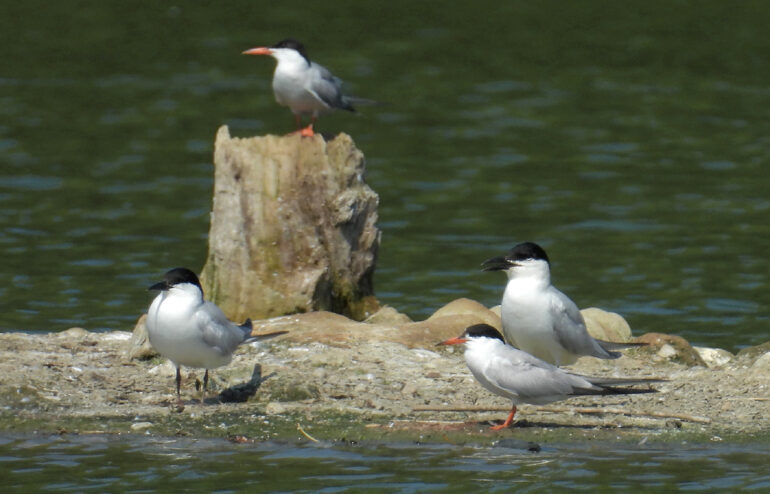
As I said in my previous report, bird sightings of note are few and far between in July, but can be quite interesting. This week, our local Common Terns were joined by two Gull-billed Terns, which seemed to have been welcomed with open arms. It is the third year in a row that two Gull-billed Terns appear between late June and early July, in spite of the fact that over the previous twenty years this species was just about unheard of here. I suspect these are always the same two individuals, who have worked in a brief stay at La Cassinazza into their annual schedule. In fact, I was so confident they would be back this year that I was waiting for them.
Meanwhile, the second clutch of Common Tern eggs have hatched after the standard 21-23 days of incubation. As far as I can tell from the lakeshore, there are nine nests with newly-hatched chicks, and two with adults still incubating. A few eggs failed to hatch and two clutches were abandoned, but this is standard operating procedure.
The only other sighting of note was the appearance of the summer’s first Green Sandpipers, quite a bit later than their usual early June arrival date.
For once, the documentation value of the photo of the week trumps its quality. Here are the Gull-billed Terns, whose bills are not only thicker than those of the Common Terns, they are also black instead of red.

Sterna zampenere

08 Jul 2024

Report from 3 to 6 July 2024

With the beginning of July, and after a long spell of unsettled weather, summer has definitely arrived. It is a time of year when bird sightings of note are few and far between, but can actually be quite interesting. This week saw the arrival of a pair of Black-necked Grebes. The last time we saw this species here was fifteen years ago, and what’s more, this week’s pair consisted of two pristine, breeding-plumaged adults: chestnut body, black neck, golden ear tufts, and extraordinary glowing-red eyes. I have photos that document their presence, but they are not up to the standard of these reports.
Nothing else worth remarking upon happened. In the two colonies – the terns and the heronry – things are going just as expected.
For most of the year we see Cattle Egrets in their all-white, rather nondescript plumage. During the breeding season they acquire colourful tufts on their chest and back, and a wacky crest.
Airone guardabuoi
29 Jun 2024

Report from 26 to 29 June

We’ll begin with some good news: three weeks ago we found an injured White Stork, with two chicks still in the nest. The remaining adult successfully managed to raise them on its own, and now the two juveniles are ready to fledge. As a whole, the local White Storks will have fledged seven young this year.
Almost all of the Common Tern chicks that hatched in May survived and have now fledged. This was an excellent outcome and the terns must have been very pleased with it, so much so that they have laid a second clutch. In practical terms, this doubles the number of bests in the colony, and if we add up the first and the second clutches, the total number approaches thirty. Fantastic. Never before had our tern colony been so successful.
Once again, the Spotted Flycatchers build a nest under the farmhouse porch. The juveniles left the nest a few days ago, and the female is already incubating a second clutch. It is up to the male to teach the fledglings how to be a flycatcher.
Pigliamosche
20 Jun 2024
Tuffetto

Report from 17 to 20 June

The half dozen Teal and several Garganey that re-appeared in recent days are best considered summer visitors, meaning birds that should be nesting somewhere else but failed to either complete their migration or find a mate: in other words, a sorry bunch of losers. Truth be told, the Garganey could potentially be breeding here, but these individuals seem merely to have chosen La Cassinazza as a safe haven to complete their moult, as a hundred or so Mallards are also doing.
The heronry has expanded and now takes up the entire island. I had compared it to a crowded apartment building, but now it brings to mind a city divided by class and neighbourhood. On the outskirts are the slums, where the Sacred Ibis crowd on top of one another among dried branches and dead shrubs. There is then a large residential area, which hosts the Cattle Egrets and Pygmy Cormorants, with some breathing room and a little greenery. The Night Herons and Little Egrets have their own posh enclaves on the taller trees, hidden from sight and surrounded by lush vegetation.
For several weeks now the Starlings have been forming an evening roost in the reedbed. There are only a few hundred birds using it so far, with small flocks bombing directly into the reeds, without bothering with acrobatics.
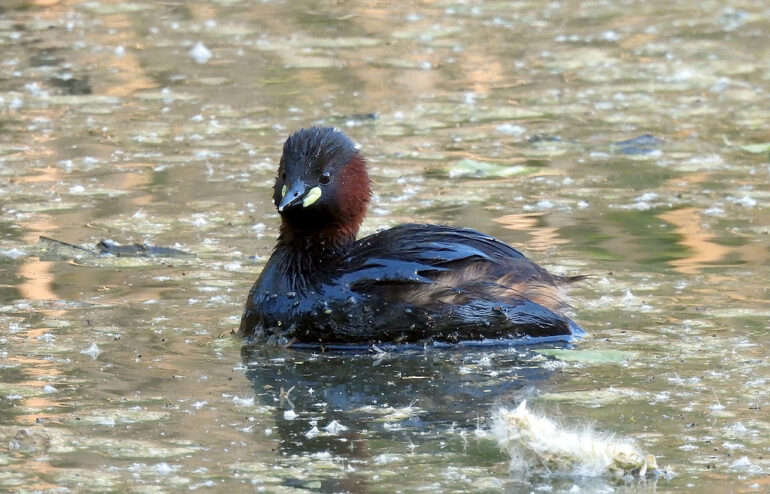
This year, there are at least four and as many as six breeding pairs of Little Grebe at La Cassinazza, an excellent comeback compared to the recent past.
Tuffetto
15 Jun 2024
Astore juv

Report from 11 to 13 June

In one final burst of migration, several small flocks of White Storks flew towards the north-east after a series of thunderstorms, greeted by our local storks as they passed by. The migration period of White Storks is very protracted, especially for non-breeding immatures – who are in no hurry, as they don’t have a schedule to keep to – and essentially can take place all year round, to the extent that the latest northbound individuals can cross paths with the first birds to head south.
In the Common Tern colony, a few juveniles are already flying about. Those that have not fledged yet enjoy long swims; lucky for them, large predatory fish have been removed from the lake. They are able to swim back to the nest, but occasionally end up on one of the gravel island or on a nest that’s not theirs. In any case, their parents are always able to find them, even when they are swimming in the middle of the lake. Clear evidence of this came when a thunderstorm unmoored one of the floating platforms and moved it over 50 meters away from its original position, with nest and chicks, but the two adults continued to care for their floating brood without batting an eye.
Two Whiskered Terns put in an appearance as well.
Over the course of two days, the juvenile Goshawks left the nest. The strongest bird, depicted in the photo, was the first to leave, immediately followed by its sibling, and only on the next day by the smallest and weakest of the trio. They didn’t exactly fledge so much as jump from one branch to the next while flapping their wings. One brave Golden Oriole was all it took to put them on their back foot.
Astore juv
09 Jun 2024

Report from 5 to 7 June

This week’s guest of honour was a flock of Pochards, five drakes and one hen. This diving duck finds little suitable habitat in the shallow waters of La Cassinazza, and they never stay long.
An unfortunate event absorbed all of our attention: one of the White Storks that breed locally had an accident. It was noticed by some passers-by, who initiated a cascade of phone calls that eventually reached the Provincial Police. Together with one of their officers, and in front of concerned audience comprising half of the local village – all of six people – we managed to rescue the injured animal and take it to a wildlife hospital. Unfortunately, the injury is too serious, and the stork will never be able to fly again. There was quite a moving moment when the White Stork’s partner, which was watching the scene from atop their nest, flew in circles over the injured bird, calling to it. This was followed by a farewell ceremony with much bill clattering, before the healthy bird returned to the nest to care for the chicks. It brought tears to the eyes of some in the audience.
The butterfly family Pieridae, also known as Whites and Sulphurs, comprises many, often look-alike species. Of the species that occur at La Cassinazza, the Eastern Bath White (Pontia edusa, also known as Pieris edusa) is the least common.
Pontia edusa