Author: Violetta

03 Jun 2024
Sgarza ciuffetto

Report from 28 to 30 May

The heronry is bustling with activity. The Sacred Ibis have massed their nests together on the dead bushes – which dried up due
to the massive numbers of the ibis themselves – leaving the green saplings to others: Cattle Egrets, Night Herons, Little Egrets
and Pygmy Cormorants, all of which are either incubating eggs or still building nests.
Things seem to be going well in the Common Tern colony, in spite of a recent series of thunderstorms. There are 13 active nests
so far, and it seems at least two more will soon be added. Five nests have hatched their eggs, and almost all of them host two
chicks. Common Terns lay three eggs, but they are rarely able to fledge all three: the youngest – or the unluckiest – of the chicks
quickly dies. As it is, the third egg is basically an insurance policy. While it may appear cynical or cruel, this is indeed the best
strategy. We cannot apply human morals to the natural world.
We cannot apply human standards of beauty either, although we must admit that herons rarely excel in this regard, with one
notable exception, at least in my judgement: the Squacco Heron, undoubtedly one of the most graceful of our summer birds.

Sgarza ciuffetto


29 May 2024
Moretta

Report from 24 to 26 May

With the endless rains we are having, the meadows have turned into lagoons, the woodlands are flooded, and everything else is mud.
Under the rain, the eggs in the Common Terns’ nests have begun to hatch. This was my last foray into the heart of the colony. The
chicks are only a few days old and can’t move much; as I approach, they just flatten themselves against the ground and remain
motionless. Once they are a little older, they tend to panic and scamper away everywhere, even falling into the water, and this would
throw the colony into chaos. From now on, I will only watch from a distance.
We had numerous Honey Buzzard sightings, and I cannot say whether they all concerned passing migrants or if it was always the same
few individuals. In any event, they were all very enjoyable: with their long, black-bordered and barred underwings, Honey Buzzards are
truly beautiful birds.
A pair of Tufted Ducks put in a visit. This is a very unusual species here at La Cassinazza, which lacks the deep water preferred by this
diving ducks. In its black-and-white formal wear, the drake is very dapper.

Moretta

22 May 2024
Svasso maggiore

Report from 18 to 20 May

As migration winds down, the breeding season starts. The most conspicuous species these days is the Marsh Warbler, with
numerous individuals singing from the reedbed both day and night. By listening closely, one can identify the countless species –
from many different families – they imitate in their songs.
The heronry has gotten very lively. The plants where the herons nested last year have dried out due to the excessive number of
birds, and the herons moved a few meters away, using new bushes in the same stand of willows. The Sacred Ibis followed them,
and are already building one of their giant communal nests.
This spring has been cool and rainy, with only a few days suitable for watching butterflies. It is not a surprise that we haven’t
seen many. While numbers have been low, diversity has been good, and I have already seen 22 species so far. The last to
appear, just a few days ago, was the Lesser Purple Emperor (Apatura ilia).
The Great Crested Grebe is back on the main lake, where it has not breed for several years. A pair seems to have settled in, and
I hope to see evidence of nesting soon.

Svasso maggiore

15 May 2024
Habrosyne pyritoides S03

Report from 11 to 13 May

Spring migration this year seems to be rather drawn out: it is almost mid-May and we are still seeing Chiffchaff, Willow Warbler,
Bonelli’s Warbler, Icterine Warbler, Red-backed Shrike, Garden Warbler, and even Sedge Warbler, the first of which arrived in
early April. Bee-eaters are also numerous, in what is traditionally the peak of their passage
The songs of Nightingales, Blackcaps, Cetti’s Warblers and Golden Orioles are now the aural backdrop to our days. At night, the
recently-fledged Little Owls call from the rooftops.
The Common Tern colony seems to have occupied ten nesting platforms; almost all have laid full clutches and they seem to be
well protected from predators. The three nesting pairs of White Stork in the immediate vicinity all seem to have hatched their
eggs; although we can’t see them from the ground, the behaviour of the adults clearly shows they are caring for their chicks. The
same can be said of the female Goshawk tending to her nest.
I would like to share with you the unusual beauty of this Buff Arches (Habrosyne pyritoides), a moth whose intricate and delicate
pattern is a feast for the eyes.

Habrosyne pyritoides S03

10 May 2024
Marangone minore

Report from 3 to 6 May, 2024

With the arrival of the Pied Flycatcher, Bonelli’s Warbler, Marsh Warbler, Great Reed Warbler, Spotted Flycatcher, Hobby and Honey Buzzard the ranks of spring migrants are now complete. The Savi’s Warbler continues to sing, even more lustily now. At this point, it is safe to assume if is not a lingering migrant but a territorial bird hoping to breed. Many pairs of Common Terns have already laid eggs, and my annual battle of wits with the Hooded Crows that predate their nests is back on. Most days, several Black Terns have been keeping the Common Terns company, and were even joined by a Whiskered Tern one day. As I was watching them, an extreme rarity made a brief pass, a species so outlandish it is only of interest to the most fanatical birdwatchers. It streaked across the sky and disappeared, leaving me no chance to photograph or document it. La Cassinazza has no suitable habitat for it.

Of greater local interest was a sighting of a pair of Great Bitterns flying low over the reedbed, then dropping down together. This behaviour suggests a breeding pair, and this would be a most welcome return after an absence of several year.

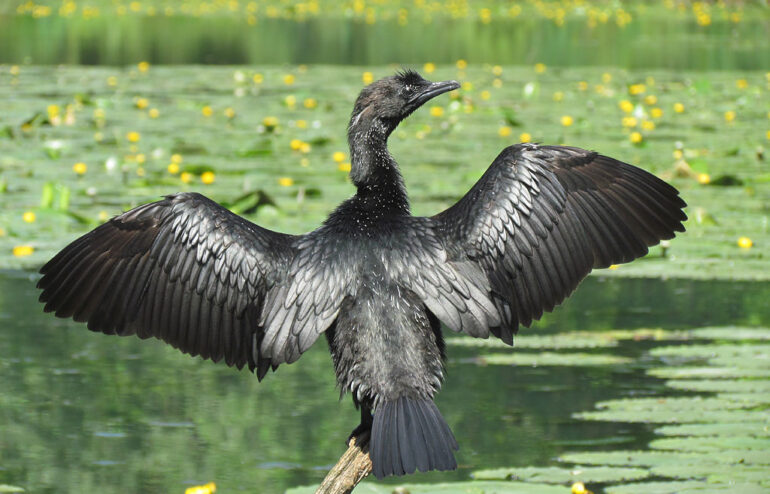
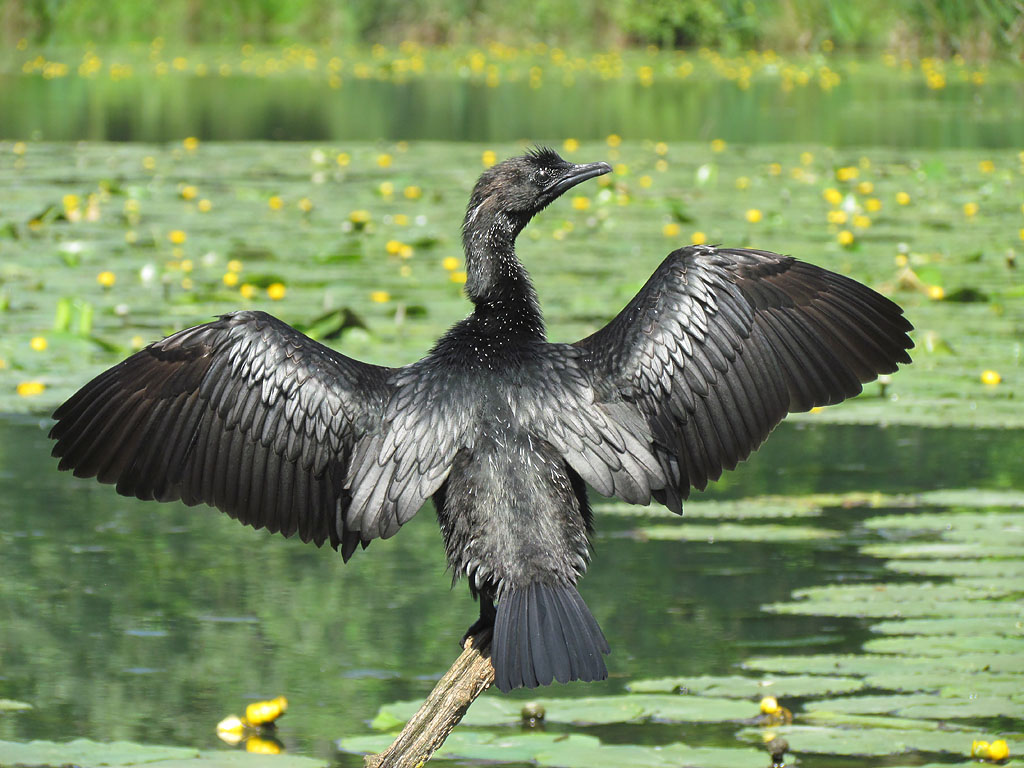
Not too long ago, the Pygmy Cormorant wasn’t even a part of the Italian avifauna. It eventually established a foothold here, and has continued to expand. Our first sighting at La Cassinazza was big news, but it is now a breeding resident and is such a routine sight that it no longer rates a mention in our weekly reports.

Marangone minore

01 May 2024
Mignattino alibianche

Report from 24 to 16 April

The weather stayed quite unsettled. When conditions are chilly and cloudy, flocks of Barn Swallows and House Martins skim the surface of standing waters in search of what few insects they can find; a few Sand Martins are with them much of the time. The Common Swifts always stay up high, and are often mere dots in the sky. As I was watching them, a Red-footed Falcon crossed my field of view.In the gloom and cold, the year’s first Bee-eaters seemed very much out of context. The insects they feed on were nowhere to be seen. The Reed Warblers are back, and as their name suggests, are singing from the reedbed. The Wood Warblers were also conspicuous by their songs. It is surprising how they seemingly arrived overnight. Many individuals were singing in spite of there being none the previous day. Also of note was a colour-ringed Spoonbill. The colour of the ring and its code indicated that it hatched and was ringed in Italy in 2022. A Black Tern and a White-winged Black Tern spent two days together on the lake, both equally disliked by the local Common Terns. While the Black Tern is a regular visitor to La Cassinazza, the second is a real rarity, with only one previous record.

With its agile and erratic flight, it proved impossible to photograph until it perched on the mud, and while the aestherics of the photo suffered somewhat, its presence was duly documented. For the non-birders reading this, the two species are quite similar, except that the Black Tern is entirely black, while the White-winged Black Tern, well…

Mignattino alibianche

23 Apr 2024
Ibis sacro

Report from 17 to 20 April

After several excessively summer-like days, we whiplashed back into wintery weather, with temperatures close to freezing and high winds that knocked down numerous trees at La Cassinazza.

Among the many waders that came and went were a Common Redshank, a Marsh Sandpiper, and a Whimbrel. The first is uncommon but regular here, the second is a bona-fide rarity, and the Whimbrel is only the third record here, although they all came in the last twelve months. This week saw many other new arrivals: Little Bittern, Squacco Heron, Pochard, Alpine Swift, Sand Martin, and Turtle Dove. An Osprey made a brief appearance and was immediately chased off by the local Buzzards. A dozen Common Terns have settled into the colony, fighting, chasing each other, and calling harshly as the males court the females by bringing them minnows.

The Savi’s Warbler is still reeling from the reedbed, and rather lustily at that. I have not yet been able to have a proper look at it, but I recorded the song and I have it on good authority that my identification is correct.

The Chiffchaffs and Willow Warblers are notable for their absence.

It is only the start of the breeding season, but the Sacred Ibis have already taken the heronry by storm. It’s hard to imagine a more gregarious species; if this is only the beginning, then there won’t me any room left for the other herons to nest.

Ibis sacro

22 Apr 2024

Report from 10 to 13 April 2024

Several months ago, the Wels’ Catfish that were plaguing the lake were removed, and immediately thereafter the Little Grebes returned. There are at least two territorial pairs now, perhaps three, and even a Great Crested Grebe has decided to explore. Both these species had abandoned the lake due to the presence of these large predatory fish.
Wader numbers ebb and flow: Common Greenshanks topped out at 50, Ruff at 65, Wood Sandpipers at a hundred or so, Green Sandpipers at 30, at Black-winged Stilts at a meagre 15.

The Shovelers decided it was time for them to leave, as did the last few Garganey.

Newly-arrived migrants included Black Tern, Hoopoe, Common Sandpiper, and a rare Savi’s Warbler, detected thanks to its distinctive reeling song coming from the reedbed.

Another new development this week concerns the appearance of eight Egyptian Geese. In the past I would have certainly considered them escapes from a zoo or a private collection. Now, however, the Egyptian Goose appears on the official Italian checklist as an established exotic, and in spite of myself I must accept them as a legitimate member of our avifauna. After a long spell of rain, the butterflies are finally on the wing. So far I have seen ten species, including the beautiful Scarce Swallowtail and the Painted Lady, a long-distance migrant that crossed the Mediterraean on its way from Africa. A few early dragonflies were also out, the Lesser Emperor (Anax partenope) and a Sympetrum that I was unable to identify.

Combattente

07 Apr 2024
Usignolo di fiume

Report from 5 to 7 April 2024

Migration seems to have taken a break: in the first couple of days of my stay there was very little of it in evidence; in particular, the impoundments, which looked ready to host throngs of waders, were basically deserted. It was only on my last day – in fact, my last two hours – that several dozen of each of Greenshank, Ruff, Wood Sandpiper, Green Sandpiper and Black-winged Stilt appeared seemingly out of nowhere. The complete absence of Common Snipe and Little Ringed Plover is quite surprising at this time of year.

Mallard and Teal numbers are down to a few dozen each, and the very last Garganeys are still passing through. The forty or so Shovelers that have been lingering at La Cassinazza for the last few weeks are still around.

New arrivals included Cuckoo and Purple Heron, while a Short-toed Eagle flew high overhead.

Passerine numbers were also lacklustre, the season’s first Common Redstart the only record of note. One species does seem to be quite in evidence: the Cetti’s Warbler, which can be heard singing from any suitable patch of habitats. We are glad to see it is once again numerous, given the ups and downs it has experienced in recent years.

Usignolo di fiume

02 Apr 2024
Ghiandaia

Report 31 March and 1 April 2024

A lot changed in the three weeks I spent away from La Cassinazza. Beginning with the season: winter officially ended and gave way to spring, although you wouldn’t have known it from the weather upon my return, which featured cold winds and endless rain. The landscape also changed, as the plants are in leaf and everything is green. I was told that several uncommon species were seen while I was away, the most important of which was the Crested Porcupine, for which a handful of quills had been the only evidence before now.

Many of the wintering species are now gone or nearly so: Siskin, Reed Bunting, Wren, Meadow Pipit, Goldcrest, Robin, Penduline Tit and Coal Tit. They have been replaced by numerous new arrivals: Barn Swallow, House Martin, Common Swift, Sedge Warbler, Willow Warbler, Night Heron, Wood Sandpiper, Greenshank, Spotted Redshank, Black Kite, the first Common Terns, a nice flock of eight Black-tailed Godwits, and many Black-winged Stilts. Osprey, Whimbrel, and Whiskered Tern all put in brief appearances.

The Jay is a very challenging bird to photograph, as it is wary, shrewd, and elusive. I had been trying for years to get a good image.

Ghiandaia