Author: Violetta

10 Mar 2024
Picchio nero vprint

Report from 5 to 8 march 2024

This is an unscheduled report: I did not think I would find time for birdwatching these last few days. But it was worth it.

The most thrilling sightings concerned the large flocks of Cranes that flew over La Cassinazza almost every day. These were large flocks – between 100 and 250 individuals – and I reckon that a thousand or so Cranes flew past these last few days.

The most intriguing sighting was that of a Red Kite wearing a small harness: a GPS transmitter. A brief online search took us to the website of the international LIFE-Eurokite project and a map showing the real-time location of our kite, right over La Cassinazza. The bird in question hatched last year near Bratislava, along Slovakia’s border with Austria, and is probably heading back there right now. The wonders of technology!
In addition to the above, these early days of spring migration also brought us the first Black-winged Stilts and Ruff, a pair of Spoonbills, a pair of Shelduck, a nice flock of almost thirty Pintail and several dozen Green Sandpipers. On the other hand, the Reed Buntings and Coal Tits seem to have left.

Last but not least, the Black Woodpecker is back. It was seen briefly, but was very vocal. After an absence of several month, its return at the beginning of spring is raising hopes that it will settle here. This is a photo of last year’s individual, a male destined to remain single. It excavated a nest cavity that was left unused.

Picchio nero vprint

07 Mar 2024

Report from 28 to 29 february 2024

If we were fogbound for much of January, February was marred by a long spell of relentless rain. At this point in the season, it is safe to say that winter 2023-4 was the first one without any Great Bitterns. This had always been a regular wintering species at La Cassinazza, often with multiple individuals, ever since we started our surveys. I can’t think of a reason for this, as the habitat here has not changed. Hopefully, this is just a short-term, local phenomenon.

The only news of the last few days are the arrival of a Spoonbill and of a pair of Mute Swans; apart from them, there have been no migrants to speak of. If anything, we are noticing the first departures: we are no longer hearing Penduline Tits calling from the reedbed, and Robin numbers are visibly lower. Among the waterfowl, Shovelers remain in evidence, while the Mallards, which have already paired up, are scattered through the surrounding countryside in their search for suitable nesting sites.

Each morning, the Blackcaps, Chaffinches, and Blackbirds enthusiastically belt out their songs to welcome the spring. Soon, I will be on holiday as well, and these reports will be on hiatus for part of March.

Fringuello

28 Feb 2024
Luì piccolo

Report from 22 to 24 february 2024

An unfortunate combination of personal commitments and awful weather left me with limited opportunities to go birdwatching at La Cassinazza this week, which means I don’t have much to report. In any case, there was no reason to think there would be many bird movements with this persistent rain.

But there are always exceptions. In the driving rain I heard a flock of Cranes flying over. There has been a heavy passage in northern Italy in recent days, some say unprecedented. Having only heard them, I cannot really say how many there were.

It’s not just water raining down, either. A shower of poplar blossoms identifies the trees on whose canopies the Siskins are feeding on fresh buds, trying to fatten up as much as possible before undertaking their northward migration.

A new sound has joined the chorus of early spring songbirds: the song of the Chiffchaff. A few have been present all winter, their numbers fluctuating depending on the weather, and so far we only heard their simple call notes: their Italian name of “Luì” is a rendering of it. Now, with spring around the corner, they are belting out their typical, repetitive song, the “chiff-chaff, chiff-chaff” that explains their English name.

Luì piccolo

28 Feb 2024
Peppola

Report from 13 to 17 february

As the days grow longer and warmer, the Firecrest has come back, while most of the Goldcrests seem to be gone. Also back is the Little Grebe, for the first time since November, and the Blackcap, which had gone missing around Christmas.

The Little Owls are already courting, and their vocal battles (or perhaps they are duets?) can be heard all night long and well into the day.

The Shoveler numbers are gradually increasing; there are now between thirty and forty.

The February nights are still cold, but a few early flying months are already out and about. The lights from lampposts attracts the Dotted Border (Agriopis marginaria) and the Oak Beauty (Biston strataria). The caterpillars of both species have a great variety of host plants: oaks, poplars, hornbeams, willows, maples, blackthorn and brambles.

The Cornels are already in bloom, at least two weeks ahead of schedule compared to twenty years ago, and a few early wildflowers are also blooming.

The Brambling is exclusively a winter bird here, and its abundance varies year by year. They are invariably associated with Chaffinches in large mixed flocks. There are still some around, but soon they will also leave us for the vast forests of northeastern Europe.

Peppola

12 Feb 2024
Mestolone OJ

Report from 7 to 8 february 2024

We are starting to see some bird movements, although I don’t know whether to attribute them to actual migration or to short-range foraging movements.

Numbers of Teal and Mallard have fallen, while those of Shovelers have increased. While their migratory movements have gotten earlier in recent years, this might be a tad too early to speak of real migration. We have also been hearing numerous Skylarks. They had been essentially absent this winter until now, only to appear all of a sudden.

The Fieldfares have also reappeared. They are now feeding on ivy berries, which the Blackbirds have been feasting on all winter. The Fieldfares much prefer hawthorn berries, and will only feed on ivy as a last resort.

Speaking of food preferences, although I have not seen the Goshawk lately, I am sure it is around since I found the fresh remains of a Teal, its favourite prey.

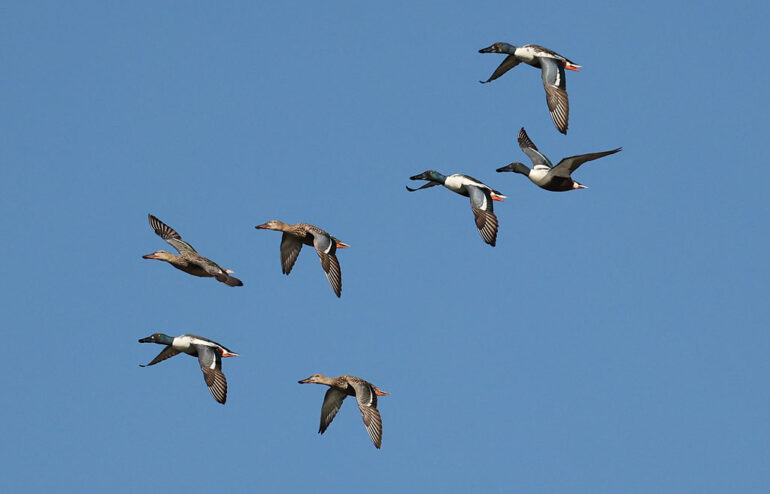
My choices for the photo of the week were quite limited. I went with these Shovelers, as they have been one of the most conspicuous species.

Mestolone OJ

08 Feb 2024
Pispola

Report from 1 to 2 February 2024

We finally had a sunny day after an endless spell of fog. Not so long ago, fog was typical of November, while January was associated with ice and frost. In the last two years, the vegetation in November was green and trees were still in leaf. Now, we only rarely see ice. We are truly undergoing profound changes.
To continue on a sour note, I am saddened to report that I have not been able to relocate our old friend the Great White Heron that was ringed in Hungary way back in 2005. Ever since, it has come back every year to its wintering territory right in front of the main farmhouse’s windows. This fall we saw it in early November, but it has since disappeared, its territory empty. I am afraid that at the ripe old age of almost 19, it has reached the end of the road.

The Meadow Pipit occurs only in winter at La Cassinazza. True to both its English and its Latin name (Anthus pratensis) it is found almost exclusively in meadows, preferably wet and with a few puddles, usually in small flocks of up to 10 or 20 individuals. They are almost impossible to see as they crouch in the grass, but when disturbed they flush and seek refuge atop bushes or trees.

Pispola

29 Jan 2024
Volpe

Report from 24 to 26 January 2024

La Cassinazza might not be the African savanna, but it too hosts its own carnivorous predators.

The Wolf has put in two or three confirmed appearances, but several years have passed since the last. The Badger leaves evident traces, and is occasionally seen. The other mustelids – the Beech Marten, Pine Marten, European Polecat and Least Weasel – are very difficult to observe, and may have been more common in the past. Weasels, for instance, were regularly seen during the day, but they seem to have disappeared of late, and we have not seen one in years.

The Red Fox, on the other hand, seems to have significantly increased in numbers; I suspect this may have been facilitated by the population explosion of Cottontail Rabbits. These non-native rabbits are small and helpless, easy prey for foxes, and as the prey species increase, so do their predators.

In January, Red Foxes are engaged in courtship. This will be followed by mating, and the pair will stay together until the cubs have been weaned; after that, they all go their separate ways. In the early morning light I ran into this pair of foxes: the brash and hopeful male, his tail cocked, was hot on the heels of the female, who did her best to project indifference and continued on her way.

Volpe
22 Jan 2024
Scricciolo

Report from 18 to 19 January 2024

Apart from the arrival of a handful of Song Thrushes – perhaps the only species on the move as early as January – I have nothing to report for the last few days.

Everything stayed as it was, including the vile weather.

Having nothing else to say, I’ll end it here.

The photo is from last week. The Wren isone of the true stars of winter at La Cassinazza: resilient, tolerant of sub-zero temperatures, territorial, and endowed with a thundering voice. And all inside a tiny body: it is one of our smallest birds.

Scricciolo

15 Jan 2024
Alzavola

Report from 11 to 13 January

It is now time for the annual International Waterbird Census. Like every year, an enthusiastic crew of birders gathered at La Cassinazza to brave the fog and the freezing temperatures, armed with binoculars, spotting scopes, and a can-do spirit.
It was all for naught. The fog was just too thick, and when it became evident that it would not lift in the afternoon, we beat a forlorn retreat. And it wasn’t just the fog: based on what little we could see and hear, we had the impression that the waterbirds themselves were making fun of us. There only seemed to be a small fraction of the birds that were around the previous, gloriously sunny day. I wonder where they went, and why they left. Sadly, the weather forecast for the next week or so promises more of the same.

In keeping with tradition, the photo that accompanies the report for the IWC depicts a duck. Drake ducks all have rather striking plumages. In my opinion, the Pintail is the most elegant, the Gadwall understated and classy, the Shoveler downright bizzare, the Wigeon and Red-crested Pochard look like a pair of clowns, and the Tufted Duck sports a dapper tuxedo. But without a doubt, the tiny Teal is the most endearing of the bunch.

Alzavola

07 Jan 2024
Poiana

Report from 3 to 6 January 2024

Nothing worth mentioning happened this week. It is that time of year when movements cease, and unless the weather is unusually harsh, the birds stay put. For this reason, this is also when the annual International Waterbird Census takes place; it is scheduled for next week at La Cassinazza. The waterfowl are here waiting to be counted. Their numbers drop somewhat on Tuesdays and Fridays, when there is no hunting and they are free to range farther afield without the risk of being shot. On hunting days they all crowd into La Cassinazza. Among the throngs of Teal and Mallards, the Shovelers, Gadwalls and Pintail are all in single digits. Two Dunlin are mixed in with the 200-strong flock of Lapwings, while a handful of Common Snipe and Green Sandpipers pop up here and there. A large roost of Cormorants and Sacred Ibis forms every night.

As far as other birds go, we are seeing the typical winter species, dominated by the Reed Bunting, Chaffinch, Brambling, Long-tailed Tit, Siskin, Blackbird, Blue Tit and Goldcrest, with smaller numbers of the other species.

Of the three new species that appeared in 2023, the Nuthatches have settled in and are still here. The Black Woodpecker was with us until September, but that lone individual has not been seen since then. The Marsh Tit was seen just once, and never again.

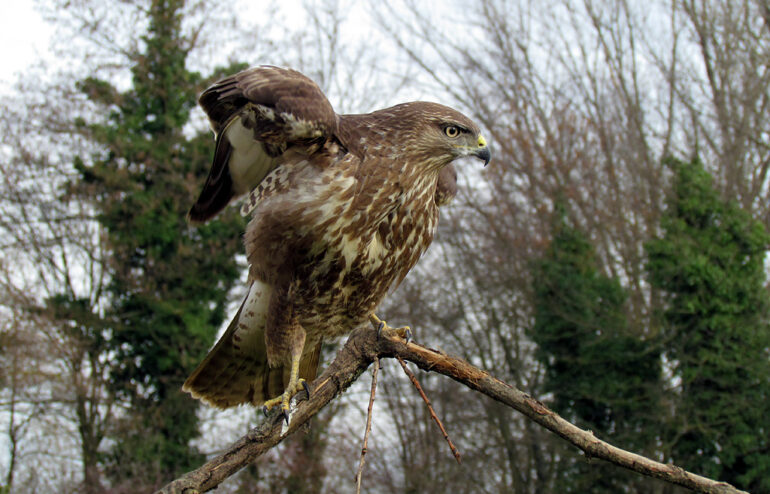
The Common Buzzard is a constant presence here, and we rarely pay it much attention. Only one pair breeds at La Cassinazza, but during the cold months the numbers are swelled by several wintering individuals.

Poiana