Author: Violetta

01 Jan 2024
Cincia mora

Report from 27 to 30 December 2024

As the year draws to an end, Bramblings have become common, with many flying out in the early morning from the reeds and willows where they spent the night.

On the other hand, the Fieldfares are gone after eating all of the available food: they left the hawthorn bushes completely bereft of berries.

Two typical wintering species are missing, at least so far: the Great Bittern and the Hawfinch. The latter is somewhat irruptive, and we expect them to go missing during years when there are no influxes, but I cannot explain the absence of bitterns: they have always wintered here, usually with multiple individuals.

The Peregrine Falcon is also missing this year, but there is an explanation. A pair of Goshawks has become resident and I don’t think there any lost love between the two species.

A total of 152 species were recorded this year at La Cassinazza, a very good total in line with the average from previous years.

This is a Coal Tit winter. It is not always so. This is a species of forests, and when the beech mast and spruce cone crops are good, the wealth of available food boosts its breeding success. This happens about every four or five year. After such a season many more Coal Tits are on the move that usual, and good numbers reach the Po Plain. The last such event was in winter 2019-20. At La Cassinazza, Coal Tits are drawn to maple trees and their large seeds.

Cincia mora

30 Jul 2023
Forapaglie

Report from 28 to 30 July 2023

We are no longer hearing the Cuckoo’s call; it is one of the first migrants to leave for Africa, second only to the Common Swift.

On the other hand, the Hobbies have become vocal: they breed in July and have chicks in the nest now, which they vigorously defend from passing Buzzards. A juvenile Spoonbill is constantly pestering its annoyed parents for food. They must have nested nearby, though I am confident it was not here at La Cassinazza. The heronry escaped unscathed from this week’s wind storms, and is now more active than ever. Most of the chicks have left the nest. Not all of them are flying yet, but they are clambering on the branches. The only ones still on eggs are the Sacred Ibis; I suspect this is a second brood after breeding earlier somewhere else.
We saw a Great Banded Greyling (Brintesiacirce) a butterfly we had only recorded once before at La Cassinazza, over ten years ago. It is quite widespread in the nearby hills, and is able to disperse over long distances, so I think it was only a passing individual.

In the thick of the reedbed, a Sedge Warbler won the award for the first southbound trans-Saharan migrant. I must confess I was unfamiliar with the juvenile plumage of Sedge Warblers, which had fooled me into thinking it might have been a far rarer relative.

Forapaglie

23 Jul 2023
Sterna comune

Report from 22 to 23 July 2023

A series of violent storms put an end to what will probably prove to be the hottest week of the year. The only new arrivals were a dozen Garganey mixed in with the Teal. As they were all in eclipse plumage, it took a while before I noticed them.

At this time of year, several of our resident and breeding species – including such common and conspicuous ones as the Chaffinch, Startling, Barn Swallow, the invasive Ring-necked Parakeet, Jackdaw, and White Stork – have finished nesting and appear to have moved elsewhere, or at least are being seen far less frequently. I don’t know where they went, or what drives their post-breeding dispersal. Or perhaps they are still here, silent and well hidden.

The Common Tern eggs have finally hatched. After numerous ordeals and a good dose of effort, this year we only managed to save two clutches. But at least we know what to do in the future.

The adult terns defend their nests aggressively, especially now that they have chicks. The herons flying by, including the huge Grey Herons, are met with aerial strikes. As I walk along the shore of the lake, they loudly voice their disapproval.

Sterna comune

16 Jul 2023
Ibis sacro

Report from 14 to 16 July 2023

The two hundred or so Mallards currently sojourning at La Cassinazza all appear to be females or immatures, but appearances can be deceptive. In fact, the adult males have just completed their moult into their brown and mimetic female-like eclipse plumage, which they will keep until winter.

A fresh juvenile Buzzard flushed at my arrival and tentatively flew to the nearest tree. It was an unfortunate choice, as a pair of Hobbies is nesting there, and they reacted furiously.

In terms of migration, these were the slowest days of the year, with essentially zero migrants.

Several pairs of Sacred Ibis have settled into the heronry. They are feared as egg and nestling thieves, but so far they have not caused damages: they just fight among themselves over the best sticks with which to build their nests.

All around them is chaos: many chicks are hopping around in the branches and Cattle Egrets, Little Egrets, and Pygmy Cormorants all are tending to nestlings, their nests nearly on top of each other. And the stench of guano carries to the embankment from which I watch them

I always thought that Sacred Ibis were black and white birds. I had never noticed their golden feathers; perhaps this colour becomes more intense during courtship. Even so, they are remarkably ugly animals. Not quite as ugly as a I thought, but still very unattractive.

Ibis sacro

09 Jul 2023
Airone guardabuoi

Report from 7 to 9 July 2023

An early hint of fall migration brought us about thirty Teal, a dozen each of Green Sandpiper, Wood Sandpiper, and Black-winged Stilt, several Greenshank and a single Ruff. Among the passerines, Marsh Warblers are particularly active and conspicuous. They are our latest arriving migrant and breeder, and as such they are still busy raising their young. Most have already left the nest, but they still depend on their parents to be fed. The contact calls of both adults and juveniles betray their presence.

The Purple Herons and most of the Night Herons and Little Egrets have already fledged their young, while the Pygmy Cormorant chicks, nearly fully grown, are still in the nest. The Cattle Egrets are lagging behind and are still incubating eggs.

They do so with great care; every now and again they get up to turn the eggs over with delicate strokes of their bills. I am often struck by the size of the eggs compared to the body of the birds that laid them. It must have been some effort!

Airone guardabuoi

03 Jul 2023
Tortora selvatica

Report from 1 to 3 July 2023

Some of the Common Terns are back and three pairs have once again laid eggs. Considering that incubation takes about 24 days, and that about a month goes by between hatching and fledging, any chicks will fledge no earlier than the beginning of September. They will almost immediately have to embark on a migration of several thousand kilometres, and there are no guarantees that they will make it. Nevertheless, this is giving me the opportunity to test my new “crow-proof” mesh cages that are protecting the nests: the mesh is so fine that the crows can’t get in. In spite of my fears, the terns show no hesitation in finding the entrance and shimmying their way in. Hopefully, no crow will be able to imitate them

In early June a colour-ringed Spoonbill made a brief stay at La Cassinazza. I have now received all the data from the French ringing scheme: it was ringed in 2019 at Les Saintes-Maries-De-La-Mer, in Camargue, and spent 2022 at the Thyna salt pans near Sfax in Tunisia. This species is prone to wandering, and this individual fits the pattern.

There were no new arrivals this week, but I saw the Black Woodpecker again after over a month. It must have been here the whole time, but remained silent. I have not seen the Nuthatches since they fledged their young two months ago.

One of the characteristic sounds of summer here at La Cassinazza is the song of the Turtle Dove, that soft “turrrr… turrr..” that gives it its name in English, Italian, and many other languages. It does not like to show off, and even when it sings it remains concealed in the canopy.

Tortora selvatica


26 Jun 2023
Pyropteron chrysidiforme

Report from 24 to 26 June 2023

Proper summer heat is now upon us. The only creatures that seem to enjoy it are the cicadas, happily singing away in the torrid temperatures.

The big news this week is the arrival of the Crested Porcupine. This species is expanding its range northwards, and in recent years they have been reported quite close to La Cassinazza. The quills that I found this week are proof that one was here.

In the heronry, many eggs have now hatched, and the activity of adults feeding young is incessant. The late arrivals that are still building nests must settle for exposed positions at the margins of the colony.

The only bird sighting of note was a Greenshank, the first fall migrant of this species,

Butterfly diversity is increasing, albeit slowly and later than usual. New species this week included the Queen-of-Spain Fritillary (Issoria lathonia), White-letter Hairstreak (Satyrium w-album),Scarce Swallowtail (Iphiclides podalirius), Swallowtail(Papilio machaon), and Oberthur’s Grizzled Skipper (Pyrgus armoricanus). Overall numbers remain very low.

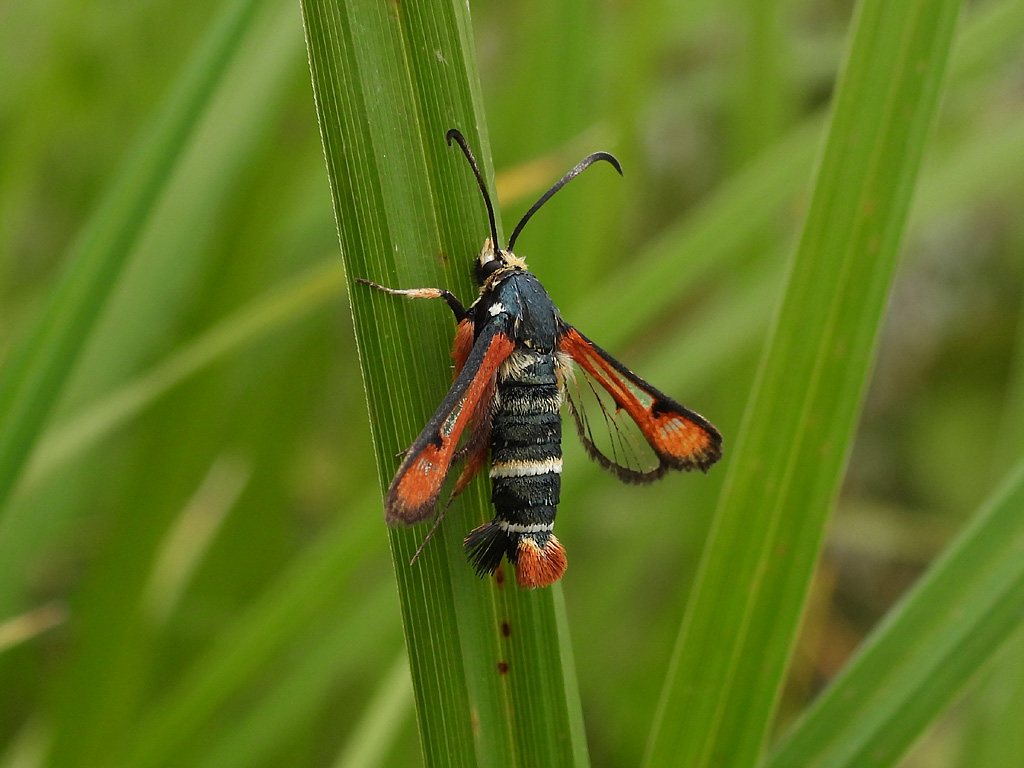
This weeks photo once again comes from the fascinating (at least for me) world of insects. It may not seem so, but this is a moth. It could easily be mistaken for a wasp, and indeed that may well be the point, as it would like potential predators to think it is dangerous. Known in English as the Fiery Clearwing, its scientific namePyropteron chrysidiformis roughly translates as “wasp-like firewing”.

Pyropteron chrysidiforme

21 Jun 2023

Report from 18 to 21 June 2023

It was a quiet week at La Cassinazza. A dozen Teal were new arrivals, and we did find a rarity: La Cassinazza’s third-ever record of Gull-billed Terns. The month of June is an excellent time to catch up with wandering terns: in the space of seven days we saw four species, in addition to our local Common Terns.

Our three local White Stork nests now host seven chicks: respectively two, two, and three. The young will fledge in a couple of weeks, and perhaps earlier for one of the nests. I assume the juvenile Goshawks have also fledged, as the timing would be right and the nest seems empty. Neither adults nor juveniles were seen all week.

Purple Herons are watchful parents, and never leave their chicks unattended in the nest. When they are out foraging they do their best to be inconspicuous, and could easily pass for a dead branch that fell in the reeds. It is only when they are in the privacy of their own home that they display the magnificence of their breeding plumage. They look so different that they deserve two photographs.


Airone rosso Airone rosso