Author: Violetta

08 Jun 2023
Pieris mannii

Report from 6 to 8 June 2023

The first returning Green Sandpiper always marks a shift in the calendar. The very last northbound migrants were still coming through in late April, and now we are already seeing the first southbound individuals. Spoonbills are also undergoing seasonal movements: in addition to the two adults that have been with us all spring, we also saw five juveniles, one of which was sporting a colour ring that identified it as coming from France’s Camargue.
Two Ruddy Shelduck drakes put in a fleeting appearance. With this species, origin – wild or escaped – is always a very challenging issue. For what its worth, these two individuals were exceptionally wary. An Osprey also put in an appearance this week.
We saw the year’s first Japanese Beetles (Popillia japonica), an invasive alien species with a devastating impact. And speaking of non-native species, in recent days we are seeing many female Pond Sliders(Trachemys scripta), a North American aquatic turtle, laying their eggs in holes they dig in the soft soil. And to think that one of my old books claimed that this species “is unable to reproduce” in Italy.
The heat and extreme drought of the past year have taken their toll on our local butterflies, which are only partially recovering now. Most of the ones we currently see are in the family Pieridae, while the other taxonomic groups, including Nymphalidae, Liycaenidae, and Hesperidae, remain very scarce. I have carried out standardized surveys for several years now: in recent weeks, the six species of Pieridae present at La Cassinazza account for over 70% of all butterflies seen.

The Southern Small White (Pieris mannii) depicted in the photo is the least known of the six, from which it can be distinuguished by minute differences in the shape and pattern of the black wing spots.

Pieris mannii

02 Jun 2023
Airone guardabuoi

Report from 1 to 2 June 2023

We are now in summer, as the weather attests, and bird activity is diminishing. Marsh Warblers and Cetti’s Warblers are stil singing, but Blackcaps and Nightingales are starting to quiet down. This is normally a rather uneventful period, although this week it was enlivened by a couple of unusual appearances: first a Black Tern, then four Pochards – four drakes and a hen – on the main pond for a few hours, and finally up to three Spoonbills flying to and fro all week.

The heronry is now the focus of our interest. This year it seems to have expanded significantly both in size and number of nests. Most numerous are the Cattle Egrets, followed in turn by the Pygmy Cormorants and Little Egrets. Night Herons are rather scarce, and there are no more than one or two pairs each of Purple Heron and Squacco Heron. It is impossible to count the nests, but there appear to be very many, and I would say that 100 to 200 is a realistic estimate.

The abundant Cattle Egret has earned the photo of the week, still on the same fallen log favoured by all the herons.

Airone guardabuoi

27 May 2023
Garzetta

Report from 21 to 27 May 2023

I tried to figure out what happened in the Common Tern colony. So far, small wire mesh cages placed above the eggs had prevented predation. This year, these same cages did not work at all. I am now convinced the culprits were Hooded Crows. Not just any crows, but the pair that has been nesting for the last few years in the woodlot across from the colony. Over time, they must have lost their fear of the unknown object and figured out how to get at the eggs. Even the decoy clutches I had made with chicken eggs were predated: all of them, except the one next to the remote camera that would have caught the thieves! Evidently, I had greatly underestimated them. I will now build a new and different version of the cages. The problem will be to prevent access on the part of the wily crows while allowing the much dumber terns to get in. The pair of Shovelers that was lingering at La Cassinazza is gone, and with it are the hopes that it would nest here. The Black Woodpecker is still around, but now that it has gone silent it is almost impossible to find. Perhaps it has resigned itself to bachelorhood. Two Spoonbills flew side by side in perfect synchrony. One had a branch in its bill, a telltale sign that they are building a nest somewhere. In the meantime, the Coot’s eggs have hatched, and the tiny black chicks with their extravagant red heads are out and about. Finally, three Black Terns put in a brief appearance. This species is nearly annual, especially in early summer.
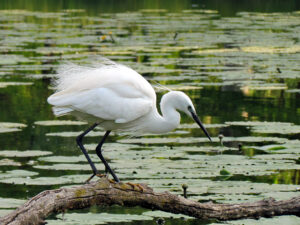
I am continuing the series of herons perched on the same log:this time, a Little Egret with its wispy plumes.

Garzetta

18 May 2023
Airone bianco maggiore

Report from 16 to 18 May

The weather was adverse the whole week, with rain and, more significantly, low temperatures. We had a nice local rarity early in the week when two Avocets showed up, only the fifth record here at La Cassinazza in over twenty years. The Goshawk is extremely cautious near the nest. I approach it no more than once a week, and only for a quick check. I thus consider myself lucky to have observed it fly into the nest, where it now has chicks. The Common Tern colony was cause for great disappointment; in the space of a few days, all the eggs that were laid disappeared. They were predated. But the culprit remains elusive. I would rule out the Hooded Crows, which in recent years have proved unable to get past the wire mesh that was placed specifically to prevent them from getting at the eggs. There are other suspects, and if – or better yet, when – the terns will lay a second clutch, we’ll find a way to identify them.

There are three white herons: the Cattle Egret, Little Egret, and Great White Egret. Starting with the last-named, I will feature them in turn in the photo that accompanies this report. If you’ll notice, the Great White Egret is standing on the same log that could be seen in last week’s photos. For all the herons, it is a great spot from which to hunt, and this allowed me to take many photos.

Airone bianco maggiore

11 May 2023
Sgarza ciuffetto

Report from 9 to 11 May 2023

Migration is coming to a close: the only waders left are a handful of Wood Sandpipers, and the only remaining waterfowl are our breeding Mallards, although a lingering pair of Shovelers is raising hopes they will nest at La Cassinazza. It would be a first.

With the arrival of the Little Bittern, all of our local summer breeders are present and accounted for.

Several Lapwing pairs were exhibiting highly territorial behaviour on the islands in the impoundments. It looked like something was afoot, and I had confirmation they were nesting when I spotted a handful of chicks from behind the grass. They had hatched only a few days prior, and were rather unlucky: they were welcomed into this world by some foul weather, rainy and cold.

Our small local colony of Common Terns already has ten active nests, most of which have a full clutch of three eggs, and all have been provided protection against predation on the part of Hooded Crows.

The Pygmy Cormorants have taken their place in the heronry, which is getting very crowded. Night Herons, Little Egrets, Cattle Egrets, and Pygmy Cormorants are all busy preparing their nests, courting, and fighting with their neighbours, amid a cacophony of odd and amusing vocalizations.

La Cassinazza is a real haven for herons. Thanks to its proximity to one of the region’s first heronries, the local herons have always used it as a foraging round, and last year they began nesting. Each species has its own seasonal patterns of occurrence, but on at least two occasions we recorded all nine European heron species here on the same day.

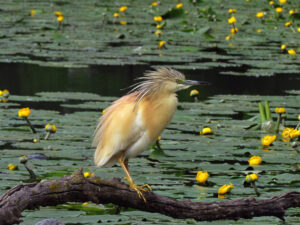
The Squacco is perhaps our most uncommon heron, but it is undoubtedly our most elegant one.

Sgarza ciuffetto

05 May 2023
Picchio muratore

Report from 3 to 5 May 2023

The explosive song of the Cetti’s Warbler can be heard just about anywhere, a sign that this species’s population density is back to what it was years ago, before a series of harsh winters nearly extirpated it. The situation is reversed for the Nightingale ; twenty years ago we would hear a singing male about every fifty meters or so, but now it is much scarcer. These two species are similar in many ways – size, appearance, lifestyle and an insectivorous diet – but they have different strategies for dealing with winter : the Cetti’s Warbler hunkers in, while the Nightingale is a long-distance migrant. Each strategy has its own set of risks, but currently, global warming is favouring the Cetti’s Warbler, while desertification and habitat degradation is hitting the Nightingale hard. The Common Terns in our local colony have already laid eggs, a fair bit in advance compared to previous years. Cattle Egrets and Little Egrets are beginning to build bests in the heronry, and I also saw a Squacco Heron lurking in the area. New arrivals included Marsh Warbler, Northern Wheatear, Spotted Flycatcher, and Honey Buzzard, and we are enjoying a steady passage of Bee-eaters. The two Shelduck that appeared last week continue to linger. The Black Woodpecker appears to range widely throughout the property, and continues to sing and call ; it does not appear to have found a mate.

On the other hand, the other species to have colonized LaCassinazza recently – the Nuthatch – arrived already paired up. They settled in quickly, and are now close to fledging young. Characteristically, they move upside-down along tree trunks.

Picchio muratore

29 Apr 2023
Tuffetto

Report from 24 to 29 April

The Wood Sandpiper migration is past its peak, and their numbers are declining by the day, from a hundred or so to a few dozen. Small flocks of Ruff, Spotted Redshank, and Greenshank are still moving through, as did a pair of Shelduck and a flock of ten stunning Glossy Ibis. The Teal are all gone – for the first time since last fall, we did not record a single individual – as are the Water Rail, at least judging from the silent reedbed. New arrivals for the season included Squacco Heron, Golden Oriole, Great Reed Warbler, Reed Warbler, Turtle Dove, and Hobby. The last-named species may not be pleased to find out that La Cassinazza is now inhabited by its arch-enemy, the Goshawk. There are once again three active nests of White Stork in the local area, as in past years ; one pair settled in later than usual. The Common Tern colony is starting to fill up, with about twenty individuals present, a few of which are already engaged in courtship. A canoe ride through the heronry revealed a Purple Heron already incubating, while the Night Herons are putting the finishing touches on their nests.

The Little Grebe is an improbable-looking ball of fluff, with two tiny, insignificant wings. It’s hard to believe it can fly – in fact, I can’t remember ever seeing one do so. And yet, somehow they migrate – do they swim, perhaps ?

Tuffetto

15 Apr 2023
Colombaccio

Report from 10 to 15 April

As the migration of the Green Sandpiper comes to an end, that of the Wood Sandpiper is reaching its peak. They are scattered all over the impoundments, so that getting a precise count is both arduous and tedious – an estimate of two hundred seems about right. Several flocks of two or three dozen Ruff came through, as did a flock of Greenshank, but in all cases they stayed for an hour or less before setting off again. Newly-arrived migrants this week included Pied Flycatcher, Bonelli’s Warbler, and Purple Heron. Now that they are incubating, the Goshawks have become ghosts. If I didn’t know they had a nest here, I would never have guessed they were around. The Nuthatches have also grown silent. They must be nesting, but I have not yet figured out where. The Black Woodpecker, on the other hand, is loudly singing and calling, and even excavated a nest cavity. It appears to be a single male exploring a new territory and searching for a mate. We wish him luck. Plenty of butterflies are on the wing – we saw fifteen different species this week- along with the year’s first odonate : the Blue-tailed Damselfly (Ischnura elegans).
For many species of birds, courtship rites center on the male offering a choice morsel to the female. Woodpigeons are vegetarian, and offering a humble seed to its mate would be underwhelming at best. But it does have a secret weapon : crop milk. This is a highly nutritious secretion, rich in fat and protein, that it uses to feed its chicks. But the females seem to appreciate it as well.

Colombaccio

08 Apr 2023

Report from 3 to 7 Aprile

We are experiencing an unseasonal cold snap; to use a stock weatherman phrase “with temperatures well below the average for the season”. In spite of the icy mornings, the song of the first Nightingale immediately puts us in a summery frame of mind.
The week’s newly-arrived migrants – and there were quite a few, including Common Sandpiper, Cuckoo, House Martin, Sedge Warbler, Sand Martin, and Wood Warbler – were overshadowed by yet another new species for La Cassinazza, a Black Woodpecker. Like the Marsh Tit and Eurasian Nuthatch that also arrived in the last six months, it is a forest species. There can be little doubt that a new ecological corridor is now linking La Cassinazza to more extensive woodlands along the Ticino river – the property is no longer surrounded by an agricultural desert.

I managed to find the Goshawk nest, with the female sitting on eggs, deep in the woods. The fact that the Goshawk and Nuthatch are both now breeding, and that Lesser Spotted Woodpeckers have increased significantly, shows how La Cassinazza’s woodlands have matured, 25 years after they were first planted.

Last week’s star guest, a Glossy Ibis, happy with the attention that was lavished upon it, including last week’s photo, seems to have resumed its journey and has not been seen for a few days.

The first Night Herons arrived around March 20, and now the full contingent is here. They have not yet turned their minds to nesting, and are mainly active at night. By day, they roost in a dense stand of willows.

Nitticora