Author: Violetta

30 Jul 2022
Orthetrum cancellatum

Report from 28 to 30 July 2022

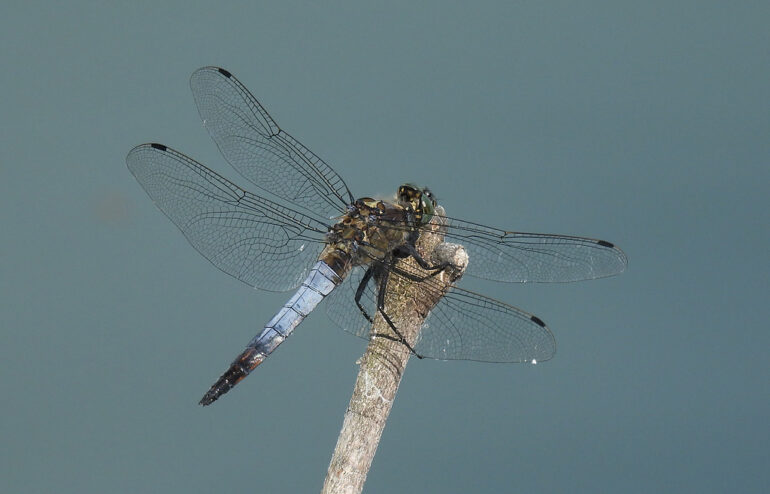
After months of drought, it finally rained. Not much, but enough to make the meadows a little greener. The Golden Orioles have been much in evidence. They sing, call, fly around, flock together, fight, and chase one another. All of this restlessness is a prelude to the migration that will soon take them back to Africa. Only one pair of Common Terns is still around, tending to a late-fledging juvenile, which is now perfectly able to fly. The others are probably out at sea by now, heading to their wintering grounds in the Atlantic. The only migrants in evidence were a Red-backed Shrike and the first of the Garganeys that I expect will be more numerous in August. The Black-tailed Skimmer Orthetrum cancellatum is one of the commonest dragonflies at La Cassinazza. As such, it is one of those species we take for granted, and had never before featured in our photo reports.

Orthetrum cancellatum

25 Jul 2022
Nitticora

Report of the 24 July 2022

I was away from La Cassinazza most of the week: an issue I had to deal with at home and the temperatures near 40 degrees conspired to keep me away. I was only able to visit today, and just for a few hours. The drought is hitting hard: the meadows and undergrowth are dry, the soil is dust covered in dry leaves, and mature trees, regardless of the species, are also suffering. In addition to the cicadas, the only songs to be heard were those of the Golden Oriole and the Lesser Spotted Woodpecker. For the first time this summer I did not hear a single Cuckoo, and I presume they have left.

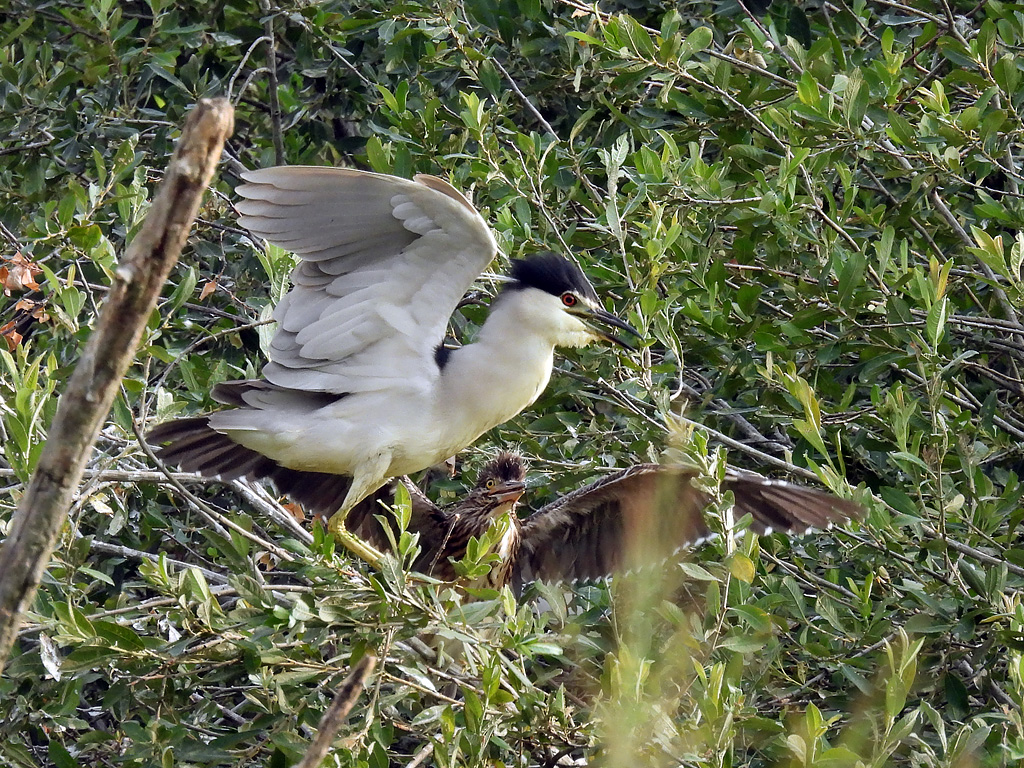
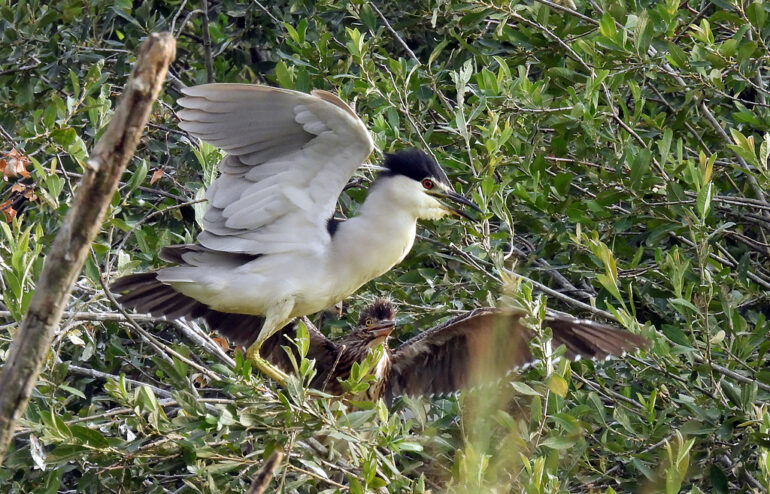
The heronry is alive with the calls of adult herons and the cries of their chicks. It continues to expand, with new Night Heron and Cattle Egret nests on some willow bushes that were empty last week.

Parental care in herons is a lively affair, with much fluttering of wings and crossing of bills (which are as sharp as a dagger, and should be handled with care). One could easily believe they were looking at a family feud instead of tender loving care.

Nitticora

17 Jul 2022
Sterna zampenere

Report from 14 to 15 July 2022

I was watching the adult and juvenile Common Terns fly around our breeding colony when I noticed a handful of different terns among them: their flight style was different, their calls were different, their bills were different, and instead of diving for fish they were skimming the water surface for dragonflies – three Gull-billed Terns! Many years have passed since the only other time we ever saw them at La Cassinazza.
Meanwhile, waders are coming back one species at a time. This week, it was the Wood Sandpiper’s turn.
Over the last few days, the heat has become extreme and the drought continues. In order to limit water loss, many trees, especially the poplars, have begun to drop their leaves.
One noticeable effect of the climate is the great scarcity of flowers and insects: butterflies, beetles, and all pollinating insects are in very low numbers. This is a seasonal and hopefully temporary effect, but it is compounding the ongoing crisis affecting insects as a whole.
Last week’s report featured a photo of a Common Tern. This week’s Gull-billed Terns provides a timely opportunity to illustrate the differences between the two species

Sterna zampenere

08 Jul 2022
Sterna comune

Report from 6 to 7 July 2022

The first returning Greenshank is confirmation that fall migration has begun.

Many juvenile Common Terns have now fledged, and all in all, while the fledgling rate may not have been as high as we had hoped, it was still satisfactory, especially considering all the perils the chicks must face. As it turns out, another problem emerged: several nests were abandoned after all the eggs were laid and incubation was almost over; this meant that many of the eggs that were laid never hatched. Predators had nothing to do with it: the eggs simply remained where they were without the adults caring for them. We wondered about the possible motive. One hypothesis is that the drought has reduced water flow in local rivers to the point that fish are scarce, and the terns simply could not find enough food to feed any hatchlings. Another hypothesis has to do with fertility: as the hatching date approached, the adults may have sensed that their eggs were infertile and abandoned them. This would also explain the unusual phenomenon of extra eggs being laid in some nests that already had a full clutch of three eggs, yet saw additional eggs being laid besides or even on top of them. Once the terns leave, we will try to collect some of these unhatched eggs, and perhaps will will then know whether or not they were sterile.
The flight pattern of the Common Terns is fast and unpredictable. After hours of fruitless efforts, I am quite pleased with this photograph.

Sterna comune

02 Jul 2022
Tarabusino

Report from 29 June to 1st July

We have been seeing a few juvenile Purple Herons lately; it looks like they may have fledged some time ago. The earliest juvenile Night Herons have also left the nest; they can’t quite fly yet, and so hop clumsily from one branch to the nest, always at the risk of falling. The first juvenile Common Terns are embarking on their tentative maiden flights, but most are still in the nest and covered in down. The White Stork chicks, on the other hand, are still far from fledging. Something seems to have gone awry this year. Out of our three nests, one is completely empty, and the other two only have two chicks each. The normal clutch for a pair of White Storks is four eggs, so we are well below average, although we still have not figured out why.
The Mallards are moulting: the drakes no longer sport their colourful plumage, and some are unable to fly, having dropped all their flight feathers. The havoc that the Japanese Beetle is wreaking on the local plant life is becoming evident: it does not merely eat the leaves, but also attacks fruits, whether wild or cultivated.
The heronry, which already hosts nests of Night Herons, Little Egrets, Cattle Egrets, Purple Herons, Squacco Herons, and Pygmy Cormorants, seems to act as a magnet drawing in new guests: right above the water levels several Least Bitterns were moving about. There must be at least two breeding pairs.

Tarabusino

26 Jun 2022
Marangone minore

Report from 22 to 25 June 2022

During my absence, the apparently small heronry at La Cassinazza grew in a most spectacular fashion. The first few pairs of Night Herons and Little Egrets that built their nests there attracted many other conspecifics, together with dozens of Cattle Egrets and good numbers of Pygmy Cormorants: now their nests are stacked on top of one another, much like a crowded apartment building. At least one nest of Squacco Heron – the rarest of our colonial herons – is also present. At the same time, the Common Tern eggs have hatched, as have those of our only pair of Little Ringed Plovers: their chicks are immediately autonomous, and while they are no bigger than a walnut, they are already scampering about under the watchful eyes of their parents. There were a few unexpected visitors as well. The most significant were three Ferruginous Ducks, a species we had not seen here for a good fifteen years. That same day we saw an Egyptian Goose, which we cannot consider truly wild, as its native range is south of the Sahara and it is common in captivity.
A dozen Green Sandpipers and a handful of Teal herald the start of post-breeding migration. Much less welcome was the appearance of the dreaded Japanese Beetle (Popilla japonica), an invasive alien pest that causes extensive damage to plants by skeletonizing their leaves.

The Pygmy Cormorant is undergoing a major range expansion. Although it only appeared at La Cassinazza in recent years, it has now started to breed. Welcome!

Marangone minore

04 Jun 2022
Capriolo

Report from 30 May to 3 June 2022

Early summer is typically a quiet and uneventful period: migration is but a memory and breeding birds have largely stopped singing. Still, La Cassinazza always has a suprise in store, and our blind stupid persistance is often rewarded. This week we added yet another new species to La Cassinazza’s lengthy bird list: a White-winged Tern spent an entire day exploring the lake. I must admit that one of us had long predicted this species as the most likely new addition to the site list. We also found a new butterfly, the Wood White (Leptidea sinapis), a small white butterfly with small black spots on the wings. Not exactly a spectacular species, and for this reason, it may well have been present for some time and simply overlooked. It is typical of woodlands and forest margins, and its presence is evidence that La Cassinazza’s wooded habitats have reached maturity.My main concern at this time of year is the welfare of our small colony of Common Terns, which now counts at least 15 active nests, all protected from the predatory Hooded Crows. Every once in a while, it’s time for me to take a break, and I will skip the next couple of reports.
Until I’m back, I’ll leave you with this photo of a mother and her fawn.

Capriolo

28 May 2022
Gabbianello

Report from 23 to 27 may 2022

Today I can say it without a doubt: the Night Herons are nesting at La Cassinazza. It took a great deal of patience and keen eyesight, but I was finally able to find at least five or six Night Heron nests with incubating adults among the dense vegetation. There appear to be other herons with them: one or two pairs each of Little Egret and Purple Heron. We will have to wait until the leaves fall next winter to be able to count the nests and know exactly how many there are. Small as it may be, the new rookery is one of the crowning achievements of the renaturalization project at La Cassinazza: a dream come true after twenty-five years.
Everything else faded into the background this week. Among butterflies, we saw the year’s first Large Copper (Lycaena dispar), no longer a rarity, but always worth noting.
Birdwatchers will be interested in the second-calendar-year Little Gull that put in an appearance. This is only the second record for La Cassinazza, with the first coming way back in 2001. Such a rarity deserves a photograph, even though I will admit that the quality of the image is well below our usual standards, and that the plumage of a worn immature bird is nowhere near as attractive as that of an adult.

Gabbianello

22 May 2022

Report from 17 to 21 may 2022

When I entered that patch of flooded woodland with my canoe – a captivating experience in its own right, akin to rowing in a tropical rainforest – I flushed over twenty Night Herons. Above my head, in the dark and tangled canopy, I could see piles of sticks. Nests. Made by the Night Herons, presumably. But try as I might, I was unable to see a Night Heron on the nest: from dry land, the nests are completely invisible. Watching the Night Herons got me no further: I could barely see them, silent and motionless, and could not figure out what they were doing. If the Night Herons really have established a small nesting colony at La Cassinazza, this would be of extraordinary importance. For the time being, I’d rather be cautious and wait for additional observations to be sure: if and when the nests will have chicks, their calls and the adults bringing them food will remove all doubt.
Turning now to birds that are certainly nesting here, the Common Terns all laid eggs at the same time, and now there are a dozen nests each with a full clutch of three eggs. At the edge of the tern colony, a pair of Little Ringed Plovers s also nesting.

Finally, I was able to see several Little Bitterns, the last of our summer breeders to arrive, and a number of new butterflies and dragonflies for the year.

Corriere piccolo

16 May 2022
Spatola

Report from 10 to 15 May 2022

In the space of a few days, spring has turned to summer, both climate-wise, with a spike in temperatures, and in terms of our birdlife, with migration essentially over and the breeding season well underway. All migrant waterbirds are gone, and the Honey Buzzard was the sole species that was still passing through. Regardless of what the calendar might say, spring is well and truly over.
Marsh and Reed Warblers have finally arrived, a good two weeks behind schedule, while Great Reed Warblers also haunt the reedbed. Alas, their songs are timid and sporadic, suggesting there are only a handful of individuals of each. The Common Tern colony is off to a roaring start, with already ten couples incubating eggs. Several Black Terns kept them company throughout the week.
For once, our most significant sighting of the week was not a rare bird, but a reptile: the Aesculapian Snake. After our first-ever sighting last year, we can now be confident that this elegant, arboreal snake is residing at La Cassinazza.

A few weeks ago, one to three Spoonbills returned to La Cassinazza, after an absence of several months. They are only present intermittently, and are quite wary, making photography a challenge.

Spatola