Report from 9 to 11 May 2023
Migration is coming to a close: the only waders left are a handful of Wood Sandpipers, and the only remaining waterfowl are our breeding Mallards, although a lingering pair of Shovelers is raising hopes they will nest at La Cassinazza. It would be a first.
With the arrival of the Little Bittern, all of our local summer breeders are present and accounted for.
Several Lapwing pairs were exhibiting highly territorial behaviour on the islands in the impoundments. It looked like something was afoot, and I had confirmation they were nesting when I spotted a handful of chicks from behind the grass. They had hatched only a few days prior, and were rather unlucky: they were welcomed into this world by some foul weather, rainy and cold.
Our small local colony of Common Terns already has ten active nests, most of which have a full clutch of three eggs, and all have been provided protection against predation on the part of Hooded Crows.
The Pygmy Cormorants have taken their place in the heronry, which is getting very crowded. Night Herons, Little Egrets, Cattle Egrets, and Pygmy Cormorants are all busy preparing their nests, courting, and fighting with their neighbours, amid a cacophony of odd and amusing vocalizations.
La Cassinazza is a real haven for herons. Thanks to its proximity to one of the region’s first heronries, the local herons have always used it as a foraging round, and last year they began nesting. Each species has its own seasonal patterns of occurrence, but on at least two occasions we recorded all nine European heron species here on the same day.
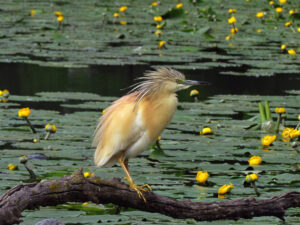
The Squacco is perhaps our most uncommon heron, but it is undoubtedly our most elegant one.